
Explore Palermo: A City That Feeds You Before It Shows You Anything
To explore Palermo is to understand immediately that this is a city where food is not a side attraction but the primary event. The street food culture of Palermo is among the most vivid and deeply rooted in Italy — a direct inheritance of the Arab, Norman, Spanish, and Bourbon influences that shaped the city over twelve centuries of layered history. It operates in the markets, on the corners, from carts and grills and improvised counters that have occupied the same spots for generations. Before you see a cathedral or a palace, Palermo will have fed you something you did not expect and will not forget: a panino con la milza from a cart in the Ballarò market, a piece of sfincione from a tray carried through the crowd, an arancina — here it is feminine, and the point matters — filled with ragù and handed over in a paper bag still hot from the fryer.
The Markets: Ballarò, Vucciria, Capo
Palermo has three historic street markets, each with its own character and its own claim on the city’s identity. Ballarò is the oldest and most working-class — a dense, chaotic, intensely alive market in the Albergheria quarter where the stalls sell fish, meat, vegetables, and street food from early morning, the vendors calling their prices in a singsong cadence that has not changed in centuries. The Vucciria, once the most famous market in Sicily, has shifted in recent decades from a food market to a nightlife district, but in the early morning hours it still functions as a place where restaurants buy their fish and the city’s cooks arrive before dawn. The Capo market, behind the Teatro Massimo, is the most photogenic of the three — a covered arcade of stalls lit by hanging bulbs, with tuna heads and swordfish displayed on beds of crushed ice alongside piles of blood oranges, artichokes, and the small, intensely flavored tomatoes that are the foundation of Sicilian cooking.
The Street Food
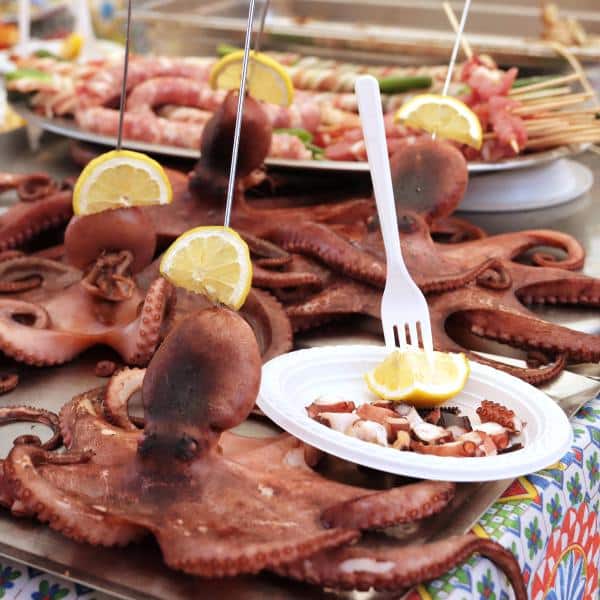
Palermo street food is a category of its own within Italian cuisine, and exploring it on foot through the market quarters is one of the most sensory-rich experiences the city offers. The panino con la milza — a bread roll filled with slow-cooked veal spleen, ricotta, and caciocavallo — is the most famous and most challenging of the city’s street foods, sold from a handful of historic carts that operate on fixed corners near Ballarò and the Vucciria. The stigghiola — grilled intestines wrapped around spring onions — is cooked over charcoal on street grills and eaten standing up. The arancina, the frittola, the crocché, the pane e panelle — chickpea fritters in a soft roll — form a rotating cast of fried, grilled, and stuffed foods that map the city’s Arab and Spanish heritage onto a contemporary street food culture that has lost none of its original character.
Beyond the Markets: Palermo’s Architecture and History
Explore Palermo beyond the market quarters and the city reveals a second identity: a place of extraordinary architectural layering, where Norman mosaics cover the interiors of Arab-style domes, and Baroque churches rise from medieval street plans. The Cappella Palatina in the Norman Palace contains one of the finest cycles of Byzantine mosaics in the world — gold-ground images of saints and angels that cover every surface of the chapel in a program of decoration that took decades to complete. The cathedral is a compendium of architectural history in a single building: Norman towers, a Gothic arch, a Baroque interior, and a Spanish dome added in the 18th century. The Quattro Canti, the monumental crossroads at the center of the old city, frames four identical Baroque facades that mark the intersection of the two main streets of the Spanish urban grid. The city rewards those who walk without a fixed itinerary and allow its contradictions to accumulate.
Palermo as the Start of a Sicily Self-Drive
Palermo is the natural gateway to a self-guided tour of Sicily — a starting point from which the road west leads to Segesta, Erice, and the Egadi Islands, while the road east crosses the island’s interior toward Etna and the baroque towns of the Val di Noto. Explore the full Sicily region to see how Palermo connects with everything the island has to offer.
Italy Trails in Palermo
Italy Trails builds Palermo into Sicilian self-drive itineraries with accommodation selected in or near the historic center, market routes and street food recommendations included in the travel materials, and onward routes mapped to connect the city with the rest of the island. Contact our team to start planning, or learn more about how a self-guided tour works.
To provide the best experiences, we and our partners use technologies like cookies to store and/or access device information. Consenting to these technologies will allow us and our partners to process personal data such as browsing behavior or unique IDs on this site and show (non-) personalized ads. Not consenting or withdrawing consent, may adversely affect certain features and functions.
Click below to consent to the above or make granular choices. Your choices will be applied to this site only. You can change your settings at any time, including withdrawing your consent, by using the toggles on the Cookie Policy, or by clicking on the manage consent button at the bottom of the screen.