
Etna Adventure: Europe’s Most Active Volcano on Your Terms
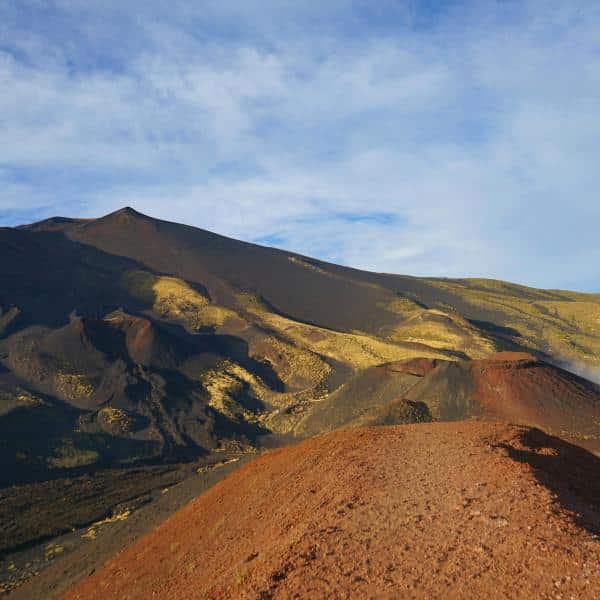
An Etna adventure is unlike any other experience in Italy. Mount Etna is the largest active volcano in Europe — a massif that rises to over 3,300 meters above the eastern coast of Sicily, visible from Catania, from Taormina, from the sea, and from much of the island’s interior. It erupts regularly, sometimes spectacularly, reshaping its own summit craters with each episode and leaving behind landscapes of black lava that range from centuries-old flows covered in vegetation to recent fields of sharp, glassy basalt where nothing grows yet. The mountain is a UNESCO World Heritage Site and one of the most geologically active places on earth, but what makes an Etna adventure genuinely memorable is not the statistics — it is the combination of volcanic terrain, alpine altitude, extraordinary food culture, and the particular atmosphere of a place that is simultaneously wild and deeply inhabited.
4×4 on the Volcanic Terrain
The higher slopes of Etna are accessible by 4×4 vehicles along tracks that cross lava fields, circle craters, and climb through zones of vegetation that change with altitude — from the citrus and olive groves of the lower slopes to the pine and birch forests of the mid-mountain, and finally to the bare, lunar landscape above 2,500 meters where the most recent eruptions have left their mark. Driving on this terrain requires vehicles suited to the conditions, and the experience of moving across solidified lava flows — some smooth and ropy, others jagged and broken — while the summit craters smoke above offers a perspective on the mountain that is impossible to gain from the road below. The northern and southern approaches to Etna offer different landscapes and different routes, and both reward those willing to leave the cable car and the visitor center behind.
Trekking the Craters and the Lava Fields
On foot, Etna reveals a level of detail that is invisible from a vehicle. The lava fields of the Valle del Bove — a vast depression on the eastern flank of the mountain, formed by the collapse of an ancient summit — are among the most dramatic walking landscapes in Italy, enclosed by walls of dark basalt that rise hundreds of meters on three sides. The path around the base of the summit craters, accessible from the Rifugio Sapienza on the southern side, crosses terrain of extraordinary variety: cinder cones, fumaroles, lava tubes, and fields of volcanic ash in colors that range from black to deep red to pale yellow depending on the mineral content. The altitude and the exposed conditions mean that the mountain demands respect and appropriate preparation, but for those who come equipped, the trekking on Etna is unlike anything available elsewhere in the Mediterranean.
The Food Culture of the Etna Slopes
What distinguishes an Etna adventure from a purely geological experience is the food and wine culture of the surrounding territory. The volcanic soils of the lower slopes produce some of the most distinctive agricultural products in Sicily — pistachios from Bronte on the western flank, wine from the Etna DOC appellation that has attracted international attention for its finesse and minerality, honey from the mountain’s wildflower meadows, and citrus from the groves that ring the base. The towns around the mountain — Zafferana Etnea, Nicolosi, Randazzo, Linguaglossa — have their own food traditions shaped by altitude, climate, and the particular richness of volcanic soil. Eating on Etna means eating food that could not come from anywhere else, prepared in ways that reflect generations of living alongside the volcano.
Etna and the Etna DOC
The wines of the Etna DOC have undergone a transformation in the past two decades that has placed them among the most talked-about bottles in Italy. The old-vine Nerello Mascalese grown at altitude on the mountain’s slopes produces a red of unusual elegance and complexity — pale in color, mineral in character, with the kind of structure that develops over years in the bottle. The white wines from Carricante, grown on the eastern flank around Milo, are equally distinctive. Visiting the wine estates of the Etna DOC — many of them working with century-old vines on terraced basalt — is a natural extension of any Etna adventure and one of the reasons the mountain rewards more than a single day.
Etna as Part of a Sicily Self-Drive
Mount Etna sits at the center of eastern Sicily, within easy reach of Taormina to the north, Catania to the south, and the baroque towns of the Val di Noto — Noto, Ragusa, Modica — to the southwest. It connects naturally into a self-guided tour of Sicily that moves between coastline and interior, between ancient ruins and volcanic landscape, between the western Sicily of Segesta and Erice and the eastern coast where Etna dominates every view. Explore the full Sicily region to see how the volcano fits into a complete Sicilian itinerary.
Italy Trails on the Etna Adventure
Italy Trails builds Etna adventures into Sicilian self-drive itineraries with 4×4 excursions arranged, accommodation selected on the mountain slopes or in the towns below, wine estate visits included, and routes that connect the volcano with the broader landscape of eastern Sicily. Contact our team to start planning, or learn more about how a self-guided tour works.
To provide the best experiences, we and our partners use technologies like cookies to store and/or access device information. Consenting to these technologies will allow us and our partners to process personal data such as browsing behavior or unique IDs on this site and show (non-) personalized ads. Not consenting or withdrawing consent, may adversely affect certain features and functions.
Click below to consent to the above or make granular choices. Your choices will be applied to this site only. You can change your settings at any time, including withdrawing your consent, by using the toggles on the Cookie Policy, or by clicking on the manage consent button at the bottom of the screen.