
Discover Favignana: The Butterfly Island off the Coast of Sicily
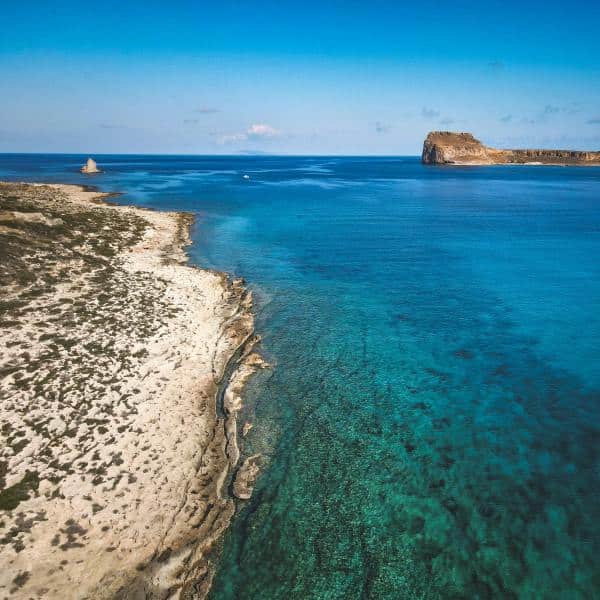
To discover Favignana is to step off the Sicilian mainland into a different tempo entirely. The largest of the Egadi Islands — named for its butterfly shape when seen from above — sits twelve kilometers off the coast of Trapani in water of a clarity and color that belongs more to the Caribbean in appearance than to the western Mediterranean. The island has no traffic lights, no chain hotels, and no sprawling resort infrastructure. What it has are coves of pale limestone and turquoise water, a small fishing town built around a 19th-century tuna factory, and the kind of silence in the afternoon that reminds you what a Mediterranean island felt like before mass tourism arrived. Favignana rewards those who come without a fixed plan and leave later than they intended.
The Water and the Coves
The coastline of Favignana is composed almost entirely of punta di calcarenite — a soft, pale limestone that has been sculpted by centuries of wind and wave action into a series of coves, inlets, and flat rocky platforms that extend to the water’s edge. Cala Rossa is the most famous of these: a former tuna fishing inlet whose red-stained walls gave it its name, now accessible only by sea or by a path from the road above. Cala Azzurra, at the eastern tip of the island, offers a sandy beach and water that shifts from turquoise to deep blue depending on the angle of the light. Bue Marino, on the northern coast, is quieter and less visited — a series of rocky platforms and small sea caves that reward those willing to walk. The island is flat enough to explore entirely by bicycle, which remains the most natural way to move between coves at a pace that matches the place.
Levanzo: The Smallest and Most Remote
Twelve minutes by ferry from Favignana, Levanzo is the smallest inhabited island in the Egadi archipelago and one of the least-visited places in Sicily. A single village of whitewashed houses, a handful of boats in the harbor, and a coastline of dramatic limestone cliffs and clear water that has remained largely unchanged for generations. What makes Levanzo exceptional, beyond its physical beauty, is the Grotta del Genovese — a sea cave on the island’s western coast that contains one of the most significant prehistoric art sites in the Mediterranean: paintings and engravings dating back between 6,000 and 10,000 years, depicting animals, human figures, and abstract symbols left by the people who inhabited these islands long before recorded history. Access to the cave is by boat or on foot with a guide, and the combination of prehistoric art and natural setting makes it one of the most unusual experiences available anywhere in Sicily.
The Egadi Islands and the Battle of the Egadi
The waters around Favignana and Levanzo were the site of the Battle of the Egadi in 241 BC — the naval engagement that ended the First Punic War and established Rome’s dominance over the western Mediterranean. Bronze rams from the warships sunk in that battle have been recovered from the seabed in recent decades and are displayed in the museum in Trapani, offering a direct connection between the turquoise water visible from the shore today and one of the decisive moments in ancient history.
Favignana and Levanzo as Part of a Sicily Self-Drive
The Egadi Islands are reached by ferry from Trapani, which sits at the end of a western Sicily itinerary that can include Segesta and Erice, the salt pans of the Stagnone, and the wine estates of Marsala. A day trip to Favignana, or an overnight stay on the island, fits naturally into a self-guided tour of Sicily that moves at its own pace through the western part of the island before heading east toward Agrigento and the Valley of the Temples. Explore the full Sicily region to see how the Egadi Islands connect with the broader Sicilian itinerary.
Italy Trails at Favignana and Levanzo
Italy Trails builds the Egadi Islands into Sicilian self-drive itineraries with ferry connections arranged, accommodation selected on Favignana or in Trapani, and routes on the mainland mapped to make the most of the western coast before and after the island crossing. Contact our team to start planning, or learn more about how a self-guided tour works.
To provide the best experiences, we and our partners use technologies like cookies to store and/or access device information. Consenting to these technologies will allow us and our partners to process personal data such as browsing behavior or unique IDs on this site and show (non-) personalized ads. Not consenting or withdrawing consent, may adversely affect certain features and functions.
Click below to consent to the above or make granular choices. Your choices will be applied to this site only. You can change your settings at any time, including withdrawing your consent, by using the toggles on the Cookie Policy, or by clicking on the manage consent button at the bottom of the screen.