
Castles of Aosta Valley: A Medieval Skyline Above the Alps
The castles of Aosta Valley are the defining feature of a landscape already defined by mountains — a succession of medieval fortifications that crown every rocky spur, every hilltop, and every strategic point along the valley floor between Pont-Saint-Martin in the east and Courmayeur in the west, their towers visible from the road below and from each other across the width of the valley. No other region in Italy concentrates this many castles in this small an area: more than seventy fortified structures of varying scale and state of preservation, built between the 11th and 15th centuries by the noble families who controlled passage through the Alps and the lucrative trade routes that followed the valley. Driving through the Aosta Valley with the castles in sight — appearing and disappearing as the road curves — is to move through a landscape that makes the Middle Ages feel not historical but simply present.
Fénis: The Most Celebrated Castle in the Valley
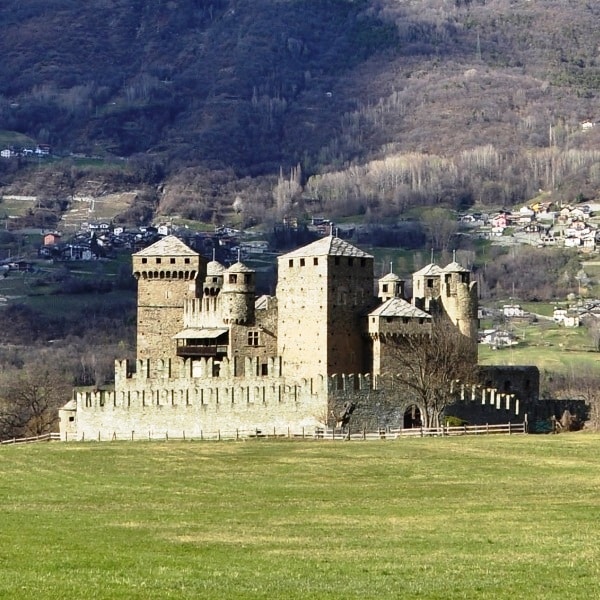
The Castello di Fénis is the most visited and most photographed castle in the Aosta Valley — a concentric fortification of towers, curtain walls, and inner courtyards whose profile, seen from the road below, appears in virtually every representation of the region. Built by the Challant family in the 14th century and expanded through the 15th, Fénis is unusual among the valley’s castles in that it was never primarily a military installation — its elaborate decorative program, which includes a cycle of secular frescoes in the courtyard depicting St. George, the Annunciation, and a procession of sages bearing philosophical inscriptions, suggests a residence designed for aristocratic display as much as for defense. The interior is accessible by guided tour and gives the clearest sense of how the Challant family — the most powerful noble house in medieval Aosta — actually lived within their fortified residences.
Issogne: The Aristocratic Palace Castle
The Castello di Issogne, at the eastern end of the valley near Pont-Saint-Martin, is a different kind of castle entirely — less military in profile, more domestic in character, its courtyard centered on a famous pomegranate fountain and its loggia frescoed with scenes of daily life that document the food, trade, and social customs of a late 15th-century alpine market town with extraordinary specificity. The frescoes — depicting a butcher’s shop, a pharmacy, a cloth merchant, a fruit seller — are unique in Italian castle decoration for their focus on the ordinary rather than the heroic, and they make Issogne one of the most humanly interesting historic interiors in the region. The castle was restored in the 19th century by Baron Vittorio Emanuele di Challant, who acquired it and furnished it with medieval and Renaissance objects in a restoration that, while not always historically rigorous, preserved the essential character of the spaces.
Sarre, Aymavilles, and the Valley Road
Between Fénis and Issogne, the valley road passes a succession of castles at close range — the Castello di Aymavilles, whose four corner towers rise from a wooded hilltop above the entrance to the Val di Cogne; the Castello di Sarre, a former Savoy hunting lodge on a ridge above the valley floor whose interiors are decorated with the trophies of the royal hunt; and the Castello di Saint-Pierre, whose round tower and commanding position above the valley make it one of the most recognizable silhouettes on the drive between Aosta and Courmayeur. The drive between these castles — stopping at those that are open, photographing those that are visible from the road — forms one of the finest self-drive itineraries in northern Italy.
Castles of Aosta Valley on a Self-Drive
The castle route connects naturally into a broader self-guided tour of the Aosta Valley that combines the medieval fortifications with the Roman monuments of Aosta, the Gran Paradiso National Park, and Courmayeur and Mont Blanc. Explore the full Aosta Valley region to plan your itinerary, then contact our team to start building your trip, or learn more about how a self-guided tour works.
To provide the best experiences, we and our partners use technologies like cookies to store and/or access device information. Consenting to these technologies will allow us and our partners to process personal data such as browsing behavior or unique IDs on this site and show (non-) personalized ads. Not consenting or withdrawing consent, may adversely affect certain features and functions.
Click below to consent to the above or make granular choices. Your choices will be applied to this site only. You can change your settings at any time, including withdrawing your consent, by using the toggles on the Cookie Policy, or by clicking on the manage consent button at the bottom of the screen.