
Discover Aosta Roman City: Augusta Praetoria at the Gateway to the Alps
To discover Aosta as a Roman city is to encounter one of the most complete and best-preserved examples of Roman urban planning in northern Italy — a city founded in 25 BC as Augusta Praetoria Salassorum, laid out on a precise rectangular grid that is still the organizing principle of the historic center two thousand years later, and endowed with a concentration of Roman monuments that rivals towns far better known on the international tourism circuit. Aosta sits at 583 meters above sea level at the confluence of the Buthier and Dora Baltea rivers, enclosed on every side by the walls of the Alps — Mont Blanc to the west, the Matterhorn and Monte Rosa to the north, the Gran Paradiso massif to the south. The combination of intact Roman architecture and one of the most dramatic mountain settings in Europe makes Aosta one of the most compelling and most undervisited cities in Italy.
The Arch of Augustus and the Roman Gate
The Arch of Augustus, erected in 25 BC to commemorate the Roman victory over the Salassi tribe and the foundation of the colony, stands at the eastern entrance to the historic center in a state of preservation that makes it easy to forget its age. The single-bay arch of travertine limestone, its proportions intact and its inscription legible, has stood here continuously since the year of the city’s foundation — making it one of the oldest surviving Roman triumphal arches in the world. A few hundred meters to the west, the Porta Praetoria — the main gate of the Roman city — preserves both of its original arched passageways between two internal courtyards, the pink limestone of the construction worn smooth by centuries of passage and weather but structurally entirely sound. Between these two monuments, the decumanus maximus — the main east-west street of the Roman city — follows exactly the same line as the modern Via Sant’Anselmo.
The Theatre, the Forum, and the Cryptoporticus
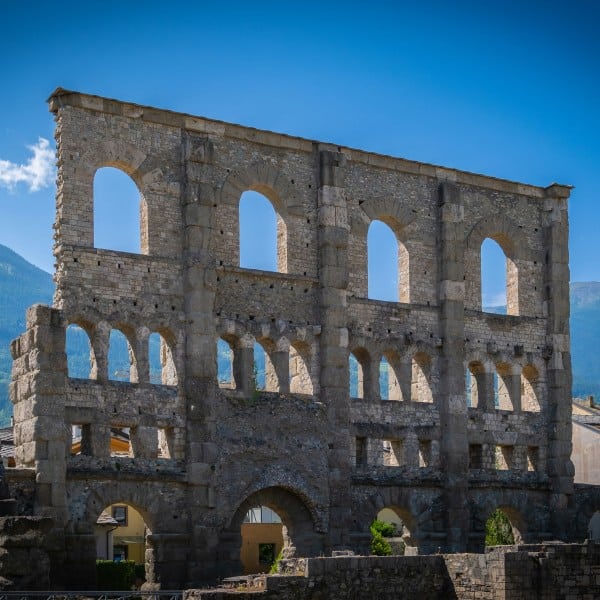
The Roman theatre of Aosta preserves its stage wall to a height of approximately 22 meters — a facade of brick arches and decorative niches that is one of the most impressive surviving examples of Roman theatrical architecture in northern Italy. The seating cavea has largely disappeared, but the stage building gives a clear sense of the scale and ambition of a theatre built for a garrison city at the edge of the empire. Adjacent to the theatre, the remains of the forum complex include the Cryptoporticus — a subterranean vaulted gallery that ran beneath the forum portico and is now accessible to visitors — and the columns of a temple whose reconstruction has been the subject of considerable archaeological debate. The medieval collegiate church of Sant’Orso, built over and around the Roman remains, adds a further layer to a historic center that moves between Roman, early Christian, Romanesque, and Gothic without pause.
Aosta Beyond the Roman Monuments
The historic center of Aosta rewards those who look beyond the Roman layer. The cathedral treasury contains one of the finest collections of medieval ivory carving in Italy, and the cloisters of Sant’Orso preserve 40 carved Romanesque capitals of extraordinary variety and narrative invention — biblical scenes, monsters, and everyday subjects carved by craftsmen of the early 12th century. The weekly market on the Piazza Cavalieri di Vittorio Veneto is one of the most animated in the region, its stalls selling local produce, cheeses, and the fontina and lard d’Arnad that define the food culture of the valley.
Aosta on an Aosta Valley Self-Drive
Aosta is the natural hub of a self-guided tour of the Aosta Valley that extends west toward Courmayeur and Mont Blanc and south toward the Gran Paradiso National Park. Explore the full Aosta Valley region to plan your itinerary, then contact our team to start building your trip, or learn more about how a self-guided tour works.
To provide the best experiences, we and our partners use technologies like cookies to store and/or access device information. Consenting to these technologies will allow us and our partners to process personal data such as browsing behavior or unique IDs on this site and show (non-) personalized ads. Not consenting or withdrawing consent, may adversely affect certain features and functions.
Click below to consent to the above or make granular choices. Your choices will be applied to this site only. You can change your settings at any time, including withdrawing your consent, by using the toggles on the Cookie Policy, or by clicking on the manage consent button at the bottom of the screen.