Hidden Borghi Marche Countryside: The Villages That Reward a Detour
The hidden borghi of the Marche countryside are the best reason to drive slowly through a region that most travelers cross in a day on the way to somewhere else. The Marche interior — the hills and valleys that rise from the Adriatic coast toward the Apennines — is scattered with medieval villages that were built for permanence and have achieved it: stone towers, Romanesque churches, fortified walls, and main squares that function as the social center of communities that have occupied the same hilltop for a thousand years. These are not hidden in the sense of being difficult to find — they appear clearly enough on any road map — but in the sense that no tour bus stops here, no guidebook gives them more than a paragraph, and the visitor who arrives on a weekday afternoon is likely to find the streets largely to themselves. That combination of quality and quietude is what makes a scenic self-drive through the Marche countryside so consistently rewarding.
San Severino Marche: Twin Hills and a Roman Past
San Severino Marche occupies a position unusual even by the standards of the Marche interior — a town built across two adjacent hills, each crowned by its own fortification, connected by a lower town of medieval and Renaissance streets that spreads between them in the valley floor. The upper town, the Castello, is the older and more austere of the two: a compact medieval settlement of stone houses and a Romanesque-Gothic cathedral whose origins go back to the 11th century. The lower town is more animated, its elliptical central piazza — one of the finest in the region — lined with porticoed buildings that reflect the prosperity of a town that was, in the 15th century, a significant center of artistic production. The Pinacoteca Civica houses a collection of works by the Salimbeni brothers, two painters born in San Severino in the late 14th century whose Gothic and early Renaissance panel paintings are among the finest produced in the Marche during that period.
Macerata and the Sferisterio
Macerata is the most significant city in the central Marche interior — a university town of considerable elegance whose historic center of brick palaces and Baroque churches sits on a long ridge above the Chienti valley. The Sferisterio, an open-air arena built in the early 19th century for the ball game of pallone col bracciale, was repurposed in the 20th century as an opera venue and now hosts one of Italy’s most atmospheric summer opera festivals, its stage set against a long neoclassical wall that provides an extraordinary acoustic and visual backdrop. The town’s position at the center of a network of smaller communes and hill villages makes it the natural base for a countryside itinerary that can extend in any direction through the Macerata hills.
The Lesser-Known Villages: Loro Piceno, Treia, Cingoli
Away from the main centers, the Marche interior offers a sequence of smaller borghi that reward those who follow the secondary roads without a fixed schedule. Loro Piceno, south of Macerata, is known for its Visner — a liqueur made from sour cherries macerated in wine and spirits that has been produced in the village for generations and bears a DOC designation of its own. Treia, a perfectly preserved hilltop town west of Macerata, has a neoclassical center of unusual completeness and a position above the surrounding countryside that makes it one of the most photogenic viewpoints in the central Marche. Cingoli, further north, is known as the Balcony of the Marche for the panoramic view it commands over the Apennine foothills and, on clear days, the entire coastal plain down to the Adriatic — a view that justifies the climb to the top of the town walls on its own terms.
The Countryside Between the Borghi
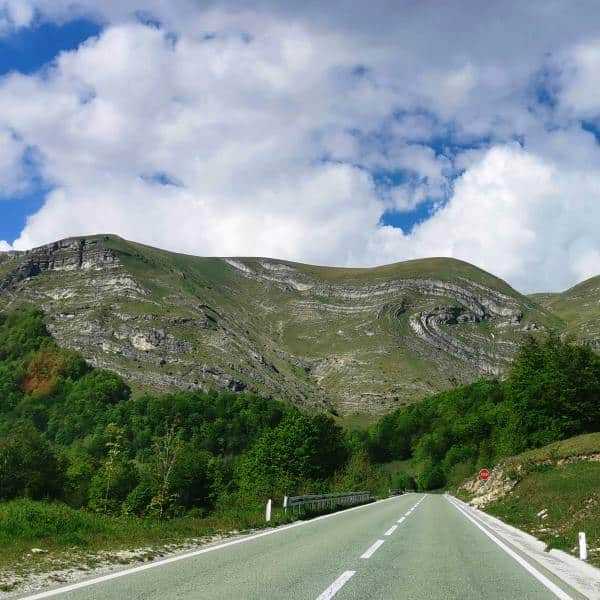
The roads that connect the hidden borghi of the Marche countryside are as much a part of the experience as the villages themselves. The Marche interior is a landscape of gentle hills, river valleys, and cereal fields that shifts character with the season — gold in summer, green in spring, misty and atmospheric in autumn and winter — crossed by a network of provincial roads that rarely carry enough traffic to disturb the sense of moving through a landscape at your own pace. The drives between San Severino and Macerata, between Treia and Cingoli, between Loro Piceno and the Sibillini foothills to the south, cover countryside of consistent beauty without a motorway kilometer in sight.
Hidden Borghi Marche on a Self-Drive Tour
The hidden borghi of the Marche countryside connect naturally into a broader self-guided tour of the Marche that can combine the interior villages with the Conero coast, the medieval walls of Corinaldo, and the castle visits at Gradara and Urbino in a single coherent itinerary. Explore the full Marche region to see how the countryside borghi connect with the coast and the mountains on either side.
Italy Trails in the Marche Countryside
Italy Trails builds the hidden borghi of the Marche countryside into self-drive itineraries with accommodation selected in the villages or in the surrounding hills, routes mapped to connect the key sites with the broader landscape, and local recommendations that go well beyond what any guidebook contains. Contact our team to start planning, or learn more about how a self-guided tour works.