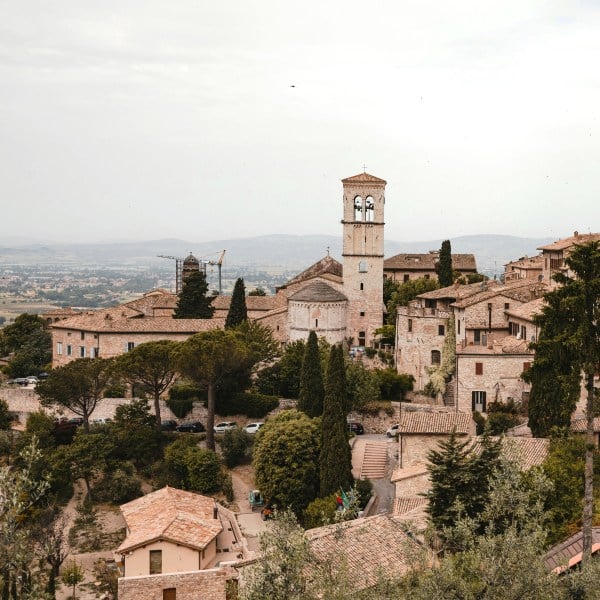
Castle Visit Marche: A Region Built on Hilltop Fortresses
A castle visit in Marche is an encounter with one of the densest concentrations of medieval and Renaissance fortifications in Italy — a region where almost every hilltop carries a tower, a walled town, or a fortress that once controlled the roads and valleys below. The Marche occupies a strip of central Italy between the Apennines and the Adriatic, a geography that made it a contested frontier for centuries: between the Papal States and the neighboring powers, between the comuni that competed for control of the river valleys, and between the noble families whose towers and castles still define the skyline of almost every town from Pesaro in the north to Ascoli Piceno in the south. Driving through this landscape on a self-drive tour is to move through a living archive of medieval Italy, with walks, local food, and wine at every stop.
Gradara: The Castle of Paolo and Francesca
Gradara is the most celebrated castle in the northern Marche — a compact walled town on a hilltop above the coastal plain, its crenellated towers and drawbridge among the best-preserved examples of medieval military architecture in the region. The Rocca di Gradara is associated with one of the most famous episodes in Italian literature: Dante placed Paolo Malatesta and Francesca da Rimini in the second circle of Hell in the Inferno, their story of forbidden love and violent death set within these walls. Whether or not the events described by Dante actually occurred here is debated, but the castle’s interiors — furnished with period pieces and frescoed rooms that evoke the late medieval court — are compelling regardless of the literary connection. The view from the walls over the surrounding countryside, with the Adriatic visible on clear days to the east, justifies the climb on its own terms.
Urbino: A Renaissance City on a Hill
Inland from the coast and elevated above the Metauro valley, Urbino is one of the finest Renaissance cities in Italy and a UNESCO World Heritage Site — a walled hilltop town whose Palazzo Ducale, built for Federico da Montefeltro in the second half of the 15th century, is among the most architecturally sophisticated buildings of the entire Renaissance period. The Galleria Nazionale delle Marche, housed within the palazzo, contains works by Piero della Francesca, Raphael — who was born in Urbino — and Titian among others, in rooms whose proportion and decoration are themselves part of the art historical argument. The town that surrounds the palace is a university city of considerable life, its medieval streets animated by students and academics in a way that gives Urbino an energy unusual for a town of its size.
Walks in the Marche Countryside
Between the castle visits and the hilltop towns, the Marche countryside offers walking routes that follow the river valleys and ridgelines of the Apennine foothills through a landscape of vineyards, olive groves, and cereal fields that has been worked continuously for centuries. The Sentiero dei Borghi Autentici connects several of the region’s lesser-known villages across the central Marche hills, and the Parco Regionale del Sasso Simone e Simoncello in the northwest offers more demanding routes through a dramatic landscape of rock outcrops and beech forest above the agricultural valleys. The walks here are less famous and less frequented than those in Tuscany and Umbria, which is precisely what makes them worth seeking out.
Local Flavors: Vincigrassi, Brodetto, and Verdicchio
The food and wine of the Marche are among the most distinctive in central Italy and among the least-known outside the region. Vincigrassi is the local baked pasta — a lasagne-like dish enriched with chicken livers, truffles, and a béchamel that differs from the Bolognese version in ways that locals discuss at length. The brodetto of the Adriatic coast — a fish stew whose recipe varies from port to port along the Marche shoreline — is the most important seafood dish in the region, its preparation a matter of local pride in Ancona, Porto Recanati, and Fano. Verdicchio dei Castelli di Jesi, the great white wine of the Marche, is one of Italy’s most age-worthy whites — mineral, structured, and produced from vineyards in the hills west of Ancona that reward those who take the time to visit the estates directly.
Castle Visits and the Marche on a Self-Drive
The Marche is ideally suited to a self-guided tour of central Italy that moves between the coast and the interior, between castle visits and food experiences, between Renaissance art and Adriatic seafood. The region connects north toward Rimini and the Romagna coast, south toward Abruzzo and the Gran Sasso, and west over the Apennines toward Umbria. Explore the full Marche region to see how the castle visits and walks connect with the broader landscape of one of Italy’s most rewarding and undervisited regions.
Italy Trails in Le Marche
Italy Trails builds castle visits, walks, and local food experiences into Marche self-drive itineraries with accommodation selected in the historic centers or in the countryside, routes mapped to connect the key sites with the surrounding landscape, and recommendations that go well beyond the obvious. Contact our team to start planning, or learn more about how a self-guided tour works.