
Milan Duomo Rooftop Terraces: Above the City, Among the Spires
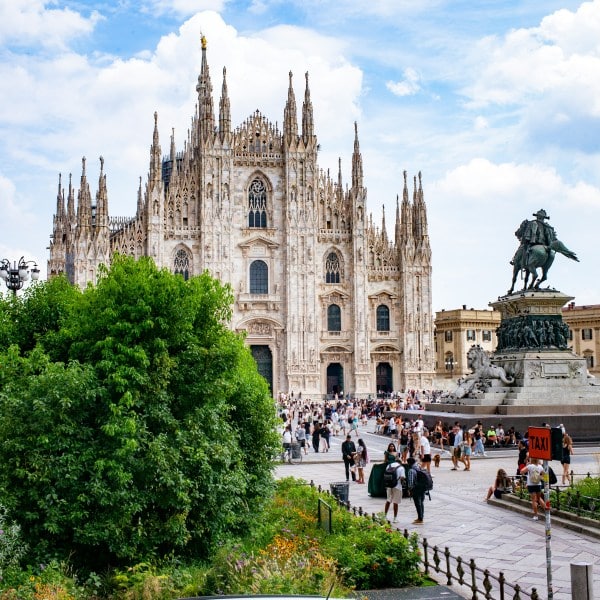
The Milan Duomo rooftop terraces offer one of the most unusual and memorable experiences in any Italian city — a walk across the roof of one of the largest Gothic cathedrals in the world, surrounded by a forest of marble spires, pinnacles, and statues that rise above the city at close enough range to examine the detail of their carving. The Duomo di Milano is the third-largest church in the world by interior volume and the largest in Italy, a building of extraordinary complexity whose construction began in 1386 and was not formally completed until 1965 — nearly six centuries of continuous work by architects, sculptors, and craftsmen who left their mark on every surface of the building. From the street below, the cathedral is overwhelming in scale; from the rooftop terraces, it becomes intimate, the individual statues and spires visible at arm’s length against a panorama of the city and, on clear days, the Alps to the north.
The Cathedral: Six Centuries of Marble
The exterior of the Duomo is clad entirely in Candoglia marble — a pale pink-white stone quarried from a single location in the Ossola valley north of Lake Maggiore, transported by barge along the canals that once ran through Milan, and carved into the statues, pinnacles, and decorative details that cover every square meter of the facade and the flanks of the building. The number of statues on the exterior — over 3,400 — is greater than on any other building in the world, and the variety of their subjects and styles reflects the different periods of their creation, from the late Gothic of the 14th century through the Renaissance and Baroque additions of later centuries. The facade, completed only in the Napoleonic period under pressure from Napoleon himself, is the most heterogeneous element of the building — a mixture of Gothic and neoclassical forms that has attracted criticism and admiration in roughly equal measure since its completion in 1813.
The Rooftop Experience
Access to the Milan Duomo rooftop terraces is via stairs or elevator from the north side of the cathedral, and the experience of arriving on the roof is immediately disorienting in the best possible sense — the city disappears behind the parapet, replaced by a landscape of white marble spires that extends in every direction. The main terrace runs along the ridge of the nave and offers the widest views, with the Alps visible to the north on clear days and the urban fabric of Milan spreading in every direction below. The Madonnina — the gilded copper statue of the Virgin that crowns the tallest spire at 108 meters — is visible from across the city and has been the symbol of Milan since its installation in 1774. Walking among the lower spires and statues, with the city audible but invisible below, is an experience that photographs of the rooftop from street level cannot adequately prepare you for.
The Interior: Stained Glass and the Scurolo
The interior of the Duomo is as complex and rewarding as the exterior, though its character is entirely different — a vast, dim space of five aisles separated by fifty-two columns, its nave lit primarily by the 15th and 16th century stained glass windows that line both sides of the building and constitute one of the largest collections of medieval and Renaissance stained glass in the world. The floor is inlaid marble in geometric patterns that extend the full length of the nave. The Scurolo di San Carlo, a crypt beneath the high altar containing the body of Cardinal Carlo Borromeo in a rock crystal reliquary, draws a steady stream of visitors with a specific devotional purpose. The Treasury museum, accessible from the ambulatory, contains vestments, reliquaries, and liturgical objects accumulated over six centuries of cathedral history.
The Duomo and the Piazza
The Piazza del Duomo that surrounds the cathedral on three sides is the social and geographic center of Milan — a large open square flanked by the Galleria Vittorio Emanuele II on the north, the Palazzo Reale on the south, and the equestrian statue of Vittorio Emanuele II at its center. The Galleria, completed in 1877, is one of the finest 19th-century shopping arcades in Europe — a glass-and-iron barrel vault connecting the Piazza del Duomo to the Piazza della Scala, lined with historic cafés, luxury shops, and restaurants whose prices reflect their location rather than their cuisine. The combination of cathedral, piazza, and galleria forms a single urban composition that is more coherent and more architecturally ambitious than anything comparable in northern Italy.
Milan Duomo on a Lombardy Self-Drive
The Duomo connects naturally into a Milan itinerary that can combine the cathedral with the Monumental Cemetery, the Pinacoteca di Brera, and Leonardo’s Last Supper before heading north toward Lake Como and the Lombardy lakes. Explore the full Lombardy region to see how Milan fits into a broader self-guided tour of northern Italy.
Italy Trails at the Milan Duomo
Italy Trails builds the Milan Duomo and its rooftop terraces into Lombardy self-drive itineraries with rooftop access arranged in advance, accommodation selected in the city center, and routes that connect Milan with the lakes and cities that make Lombardy one of Italy’s most rewarding regions to explore by car. Contact our team to start planning, or learn more about how a self-guided tour works.
To provide the best experiences, we and our partners use technologies like cookies to store and/or access device information. Consenting to these technologies will allow us and our partners to process personal data such as browsing behavior or unique IDs on this site and show (non-) personalized ads. Not consenting or withdrawing consent, may adversely affect certain features and functions.
Click below to consent to the above or make granular choices. Your choices will be applied to this site only. You can change your settings at any time, including withdrawing your consent, by using the toggles on the Cookie Policy, or by clicking on the manage consent button at the bottom of the screen.