
Milan Monumental Cemetery: An Open-Air Museum in the Heart of the City
The Milan Monumental Cemetery — the Cimitero Monumentale — is one of the most extraordinary public spaces in Italy and one of the least-visited attractions in a city that has no shortage of world-class cultural destinations. Opened in 1866 to a design by Carlo Maciachini, the cemetery occupies a large plot in the Porta Volta neighborhood of Milan and contains a collection of funerary sculpture, monumental tombs, and architectural follies that amounts to one of the finest open-air museums of 19th and 20th century Italian art anywhere in the country. Entry is free, crowds are minimal even on weekends, and the experience of walking its avenues — past marble sarcophagi, bronze portraits, Art Nouveau mausoleums, and modernist monuments — is unlike anything else the city offers. For visitors who know Milan primarily through its fashion, design, and the Last Supper, the Monumental Cemetery is a revelation.
The Architecture of Remembrance
The cemetery is organized around a central axis leading from the monumental entrance — the Famedio, a neo-medieval hall in striped stone that serves as a pantheon of illustrious Milanese — to the open field of burial plots and family tombs that extends behind it. The Famedio itself contains the tombs of Alessandro Manzoni, the author of I Promessi Sposi, and Carlo Cattaneo, the philosopher and statesman, alongside commemorative plaques for hundreds of other figures significant in Milan’s history. The family tombs that line the avenues of the cemetery represent a survey of architectural ambition spanning more than a century: Egyptian Revival temples, Greek Classical mausoleums, Art Nouveau pavilions dripping with bronze ornament, Rationalist structures in white marble, and post-war monuments of a more austere modernism. Each tomb is a statement about how a family wished to be remembered, and collectively they form a document of changing taste and changing ideas about death, memory, and permanence.
The Sculpture Collection
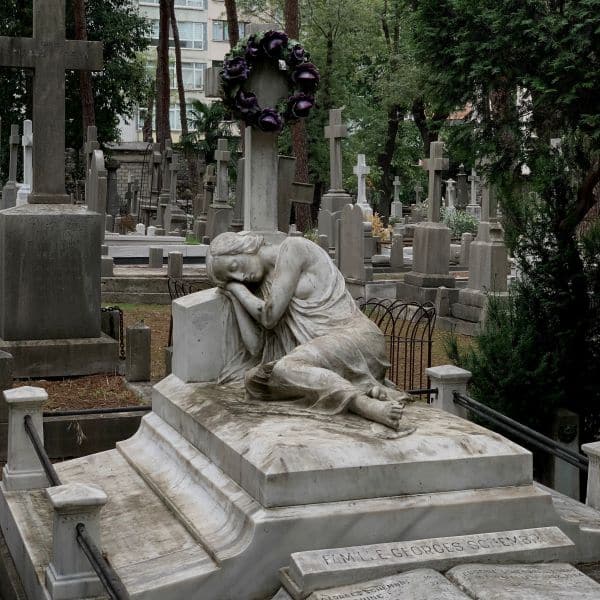
The funerary sculpture of the Monumental Cemetery is the most compelling reason to spend a full morning here. The cemetery contains works by some of the most significant Italian sculptors of the 19th and early 20th centuries — Medardo Rosso, Adolfo Wildt, Giannino Castiglioni, and Lucio Fontana among others — produced for specific tombs and still visible in the context for which they were made. Wildt’s angular, expressionist figures for the Bernocchi family tomb are among the most powerful examples of Italian symbolist sculpture anywhere. The bronze portraits and allegorical groups that mark the tombs of industrial families — the Campari, the Pirelli, the Breda — reflect the wealth and ambition of the Milanese bourgeoisie at its height, and the transition from academic naturalism to modernist abstraction is visible in a single walk through the cemetery’s avenues. The sculpture here is not in a museum context — it is outdoors, weathered, and embedded in the landscape of grief and commemoration that produced it.
Stories Written in Stone
Every tomb in the Monumental Cemetery has a story, and many of those stories reflect the larger history of Milan and Italy. The memorials to the victims of the First and Second World Wars occupy prominent positions in the cemetery’s layout, and the partisan memorials erected after 1945 — including the Monument to the Fallen of the Mauthausen concentration camp — carry a weight and directness that formal museum displays rarely achieve. The tomb of the Campari family, whose fortune was built on the aperitivo that still bears their name and whose influence on Milanese café culture is still felt today, sits not far from the more austere monuments of industrial dynasties whose names are written on the buildings and streets of the modern city. Walking the cemetery with a map and a sense of curiosity is a way of reading the history of Milan through its most personal and permanent documents.
The Monumental Cemetery in a Milan Self-Drive
The cemetery sits in the northwest of Milan’s historic center, a short tram or taxi ride from the Duomo and easily combined with a visit to the Brera neighborhood, the Pinacoteca di Brera, or the streets around Corso Como. It connects naturally into a broader self-guided tour of Lombardy that can extend from Milan toward the lakes — Como, Maggiore, Garda — or south toward the Po Valley and the cities of Mantua and Cremona. Explore the full Lombardy region to see how Milan connects with the broader landscape of northern Italy’s most populous and culturally rich region.
Italy Trails in Milan
Italy Trails builds Milan into Lombardy self-drive itineraries with accommodation selected in or near the historic center, cultural visits planned into the route, and connections mapped to the lakes and cities that make Lombardy one of the most rewarding regions in Italy for those willing to move beyond the obvious. Contact our team to start planning, or learn more about how a self-guided tour works.
To provide the best experiences, we and our partners use technologies like cookies to store and/or access device information. Consenting to these technologies will allow us and our partners to process personal data such as browsing behavior or unique IDs on this site and show (non-) personalized ads. Not consenting or withdrawing consent, may adversely affect certain features and functions.
Click below to consent to the above or make granular choices. Your choices will be applied to this site only. You can change your settings at any time, including withdrawing your consent, by using the toggles on the Cookie Policy, or by clicking on the manage consent button at the bottom of the screen.