
Cross the Brenner Pass from Austria and you enter Italy — but not quite the Italy you were expecting. The signs are in two languages. The houses have steeply pitched roofs and window boxes overflowing with geraniums. The food is dumplings and speck and apple strudel. The wine is Gewurztraminer. This is the Trentino Alto Adige — South Tyrol — a territory that was Austrian until 1919 and has never entirely stopped being so, and is better for it. The resulting culture is something Italy does not produce anywhere else: a precision and a cleanliness in the landscape, a quality of accommodation and food, and above all a setting — the Dolomites rising in every direction — that is simply incomparable.
South of the Brenner, as you descend toward Trento, Italy gradually reasserts itself. The language softens, the cuisine changes, the wines shift from Germanic whites to Teroldego and Marzemino. By the time you reach the shores of Lake Garda, you are unmistakably in Italian territory again. But between these two worlds, the roads pass through some of the greatest mountain scenery on earth.
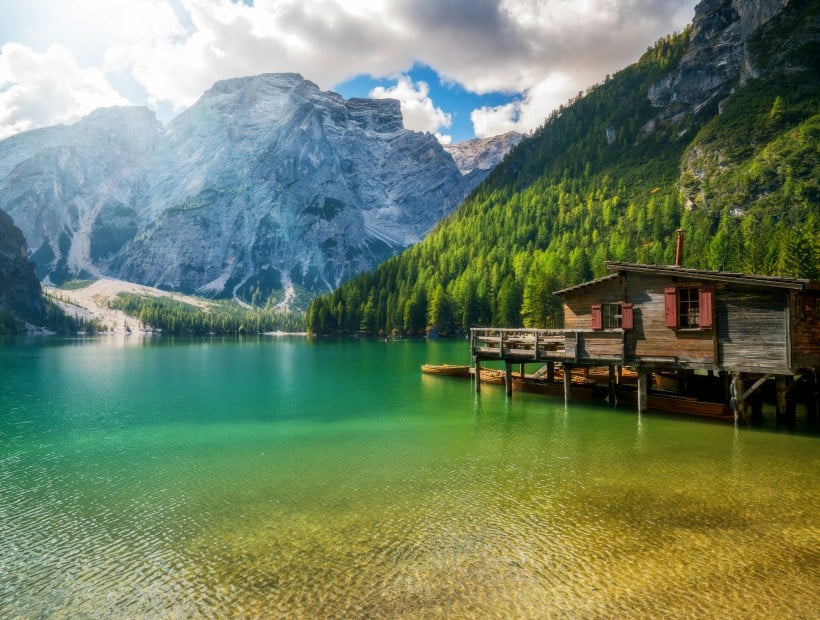
The Dolomites were inscribed as a UNESCO World Heritage site in 2009 for their extraordinary natural beauty — vertical walls of pale rock rising thousands of metres above green valleys, turning rose-pink at sunset in the phenomenon the Ladins call enrosadira. The Tre Cime di Lavaredo are the most famous formation: three stone towers above a mountain plateau, photographed so often that they have become a symbol of the Alps itself. The Alpe di Siusi is the largest high-altitude plateau in Europe, a vast meadow of wildflowers above the treeline, ringed by the jagged walls of the Sassolungo and Sciliar. The Cortina d’Ampezzo valley, host of the 2026 Winter Olympics, sits in the heart of the Dolomiti Ampezzane — a landscape of such theatrical beauty that it appears in films and fashion shoots as a kind of shorthand for alpine perfection.
But the Dolomites are not just scenery. They are roads. The Sella Ronda — a circuit of four mountain passes around the Sella massif in the Ladin heartland — is one of the great drives in Europe: 55 kilometres of pass road, panoramas in every direction, and the satisfaction of having connected four different valleys in a single day. The Passo dello Stelvio, at 2,758 metres, is the highest paved pass in the Eastern Alps and one of the most challenging and most rewarding roads a driver can attempt. The Passo del Pordoi, the Passo Gardena, the Passo Falzarego — each one a different character, each one unforgettable.
The capital of South Tyrol is a city of genuine character — an elegant mixture of Italian cafe culture and Central European precision, of Gothic churches and Art Nouveau boulevards, of open-air markets selling speck alongside focaccia. The South Tyrol Museum of Archaeology holds Ötzi the Iceman — a 5,300-year-old mummy discovered in a glacier in 1991 and now the most studied human body in history. The wine bars of the old town, serving local Lagrein and Pinot Noir alongside platters of local cheese and cured meats, are among the most civilised places to spend an evening in northern Italy.
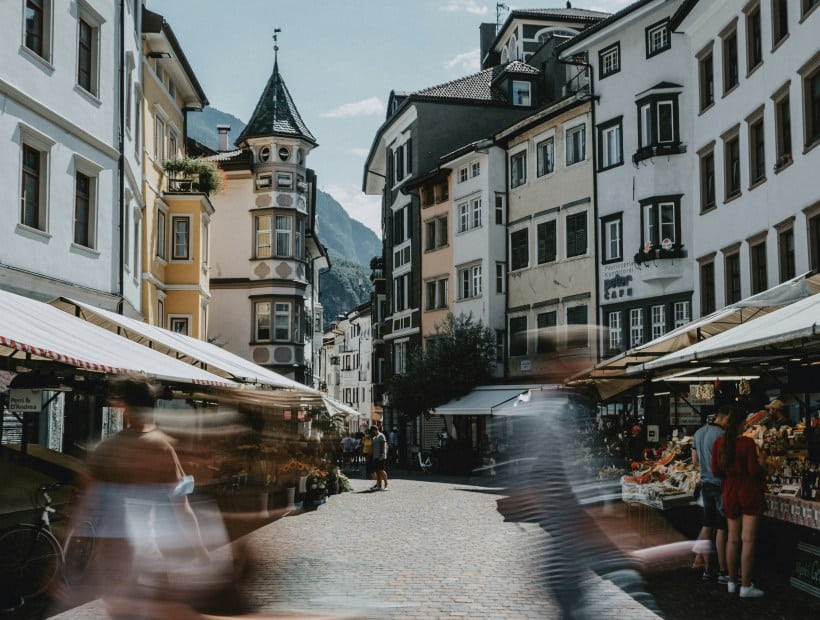
The South Tyrolean wine road — the Strada del Vino — runs through the vineyards south of Bolzano, connecting the wine villages of Appiano, Caldaro, and Termeno on a route of extraordinary beauty. This is where Gewurztraminer was born — from the village of Tramin, whose name the grape carries around the world. Pinot Grigio, Pinot Bianco, Lagrein, Schiava — the Alto Adige produces wines of remarkable quality in a landscape that looks more like the Swiss countryside than anything typically Italian. Driving this road in autumn, when the vineyards turn red and gold, is one of the quietly great experiences of the Italian north.
Behind the main valley of the Adige, dozens of smaller lateral valleys open into the mountains. The Val Gardena is the heartland of Ladin culture — a minority language that survived in these isolated valleys for two thousand years — and the base for the Sella Ronda circuit. The Val Pusteria runs east toward Austria through a wide, peaceful valley of meadows and medieval castles. The Val Venosta, in the west, is one of the driest and sunniest valleys in the Alps, famous for its apples and its Romanesque churches. Each valley has its own character, its own food, its own reason to stop the car and stay.
South of the Brenner watershed, Trentino feels unmistakably Italian. Trento — the capital — is a Renaissance city of considerable beauty, with frescoed palaces, a medieval castle, and a cathedral where the Council of Trent reformed the Catholic Church in the sixteenth century. The surrounding valleys produce Teroldego, one of the most distinctive reds in northern Italy, and the wines of the Trentodoc — Italy’s most celebrated sparkling wines after Franciacorta — are made using the méthode champenoise from Chardonnay and Pinot Nero grown on the hillsides above the Adige. Lake Garda’s northern shore — the Trentino Riviera — offers a Mediterranean climate in the heart of the Alps, with olive trees, lemon groves, and sailing in crystal-clear water.
Summer (June–August) is the classic season for the Dolomites. The mountain roads are fully open, the hiking is extraordinary, and the mountain refuges are alive with walkers from across Europe.
Autumn (September–October) brings the wine harvest, golden larches on the high pastures, and a clarity of air that makes the Dolomites look almost unreal. The tourist season has ended and the roads are yours.
Winter transforms the region into one of Europe’s great skiing destinations. Cortina, Val Gardena, Alta Badia, Kronplatz — the resorts are world-class. And the 2026 Winter Olympics have brought new infrastructure and international attention.
Spring is when the snow melts and the valleys fill with wildflowers. The passes begin to open from late May, and the region is at its freshest and least crowded.
The Dolomites were made to be driven. The passes, the valley roads, the wine routes — all of them reward the traveller who moves through them at their own pace, stopping when a view demands it, following a valley road because it looked interesting on the map. A self-drive tour through Trentino-Alto Adige is one of the most rewarding Italy Trails offers.
Italy Trails designs personalised self-drive tours that combine the Dolomites with the South Tyrolean wine road, the Ladin valleys, and Trentino’s lake shore. The region connects naturally with Northern Italy and with Lombardy for a wider journey through the Italian north.
➤ Contact us to start planning your Trentino-Alto Adige self-drive tour