
An hour east of Rome, the landscape changes completely. The motorway ends, the mountains rise, and you enter a region that most visitors to Italy never see. Abruzzo is where the Apennines reach their highest point, where wolves and bears still roam through ancient beech forests, and where medieval villages cling to hilltops as they have for a thousand years, untouched by mass tourism and indifferent to the passage of time.
This is Italy at its most raw and authentic. No crowds, no queues, no souvenir shops. Just mountains, silence, stone villages, and food that comes directly from the land around you. And the only way to reach it — the only way to truly experience it — is by car.
Abruzzo is not a region you can explore by train or bus. Public transport connects a handful of larger towns along the coast, but the places that make Abruzzo extraordinary — the mountain villages, the national parks, the hidden valleys, the Trabocchi Coast — are unreachable without a car. There are no tour buses here, no hop-on hop-off routes, no convenient shuttles. The roads are yours, and that is precisely the point.
A self-drive tour is not just the best way to see Abruzzo — it is the only way. And this is what makes it so special. You drive through landscapes that belong to you alone: mountain passes where the only traffic is a shepherd and his flock, coastal roads where wooden trabocchi rise from the sea like ancient fishing machines, and village squares where your arrival is an event because so few tourists come this way.
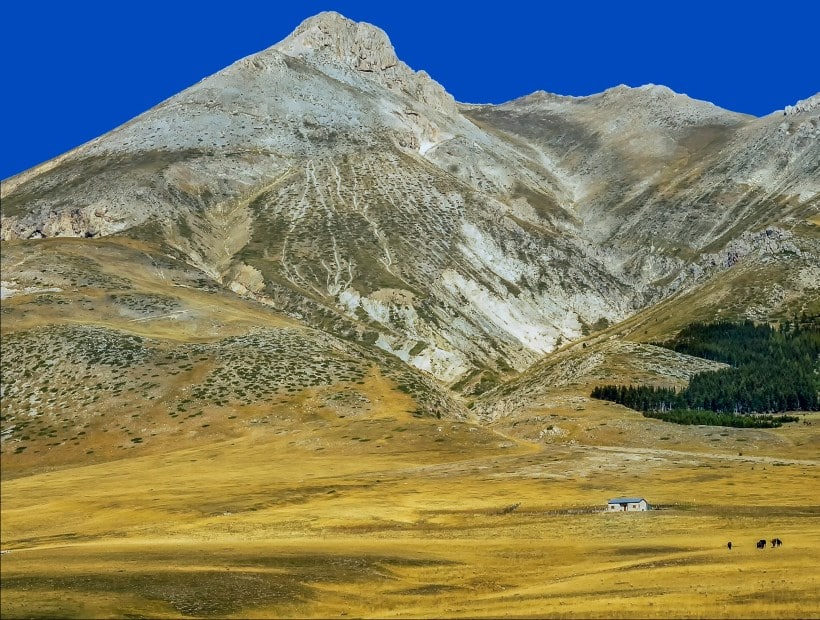
The Gran Sasso — the highest peak in the Apennines — dominates the region like a wall of rock and snow. Below it, the Campo Imperatore plateau stretches for kilometres: a vast, treeless highland that has been called “Little Tibet” for its stark, otherworldly beauty. The Maiella massif, equally dramatic, hides hermitages carved into cliff faces where monks lived in isolation for centuries. And the Parco Nazionale d’Abruzzo, one of the oldest protected areas in Europe, is home to the Marsican brown bear, the Apennine wolf, and the chamois.
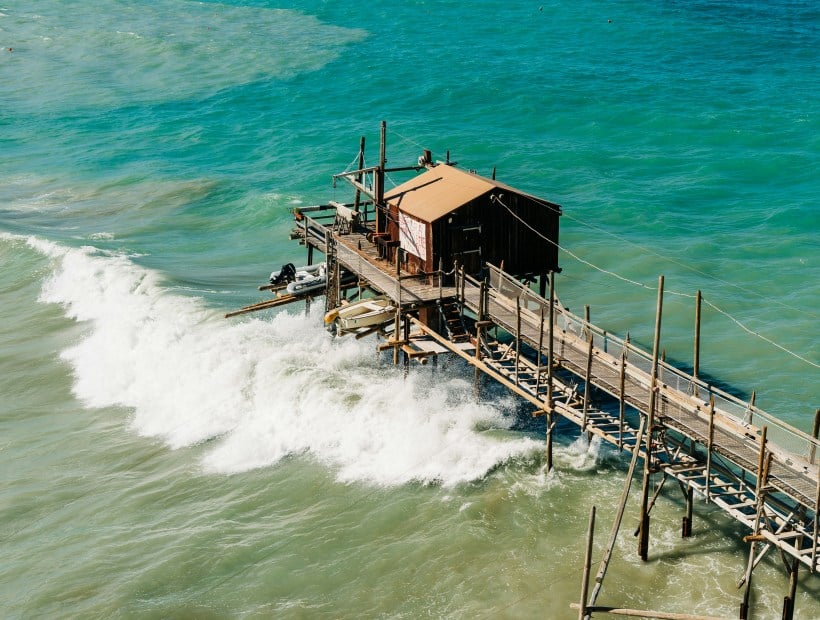
The Costa dei Trabocchi is one of the most unusual coastlines in Italy. Ancient wooden fishing platforms — trabocchi — stand on stilts above the Adriatic, connected to the shore by narrow walkways. Many have been converted into restaurants where you eat fresh fish directly above the water, with nothing between you and the horizon. Driving this stretch of coast, stopping at trabocchi and hidden coves, is an experience you will find nowhere else in the country.
Santo Stefano di Sessanio, Scanno, Pescocostanzo, Civitella del Tronto — Abruzzo’s hilltop villages are among the most beautiful and least visited in Italy. Stone houses, narrow alleys, churches with frescoes that nobody queues to see, and a pace of life that belongs to another era. In many of these villages, the population is small, the trattorias serve food made from recipes passed down through generations, and the welcome is warm precisely because visitors are still a novelty.
Abruzzo’s cuisine is mountain food at its finest: direct, generous, and deeply tied to the seasons. Arrosticini — tiny skewers of lamb grilled over charcoal — are the region’s signature, eaten outdoors by the dozen with bread and local wine. Maccheroni alla chitarra is pasta cut on a wire frame, served with lamb ragù or tomato. Saffron from the Navelli plateau, one of the finest in the world, turns up in risottos and sweets. And Montepulciano d’Abruzzo, the region’s great red wine, is the kind of bottle that makes you rethink everything you knew about Italian wine outside Tuscany.
Spring and early summer (April–June) are ideal for driving and exploring. The mountains are still snow-capped, the valleys are green, the wildflowers are extraordinary, and the coast is quiet.
Late summer and autumn (September–November) bring harvest season, truffle hunting in the mountains, and a golden light that makes the hilltop villages glow. This is when Abruzzo’s food is at its absolute peak.
Winter transforms the mountains into skiing territory — Roccaraso and Campo Imperatore are popular with Italian skiers — while the coast remains mild and atmospheric.
Because Abruzzo is almost impossible to explore without a car, a self-drive tour with Italy Trails is the smartest way to experience it. We design your itinerary around the mountains, the coast, the villages, and the food — with accommodation in places that most travellers would never find on their own. A restored masseria in the hills, a small hotel overlooking the trabocchi, a room in a village where the owner cooks dinner with ingredients from her garden.
We handle every detail: the routes that avoid the main roads and take you through the landscapes that make Abruzzo unforgettable, the restaurants that serve the real food of the region, and a smartphone with navigation and direct support whenever you need it. You drive — we take care of everything else.