
Visit L’Aquila: A City That Rebuilt Itself from the Ground Up
To visit L’Aquila today is to encounter a city in the middle of one of the most extraordinary urban reconstruction processes in contemporary Italy — a medieval and Renaissance city in the heart of the Abruzzo Apennines that was almost entirely destroyed by the earthquake of April 6, 2009, and that has been rebuilding itself, monument by monument and street by street, for the fifteen years since. The earthquake killed 309 people and left tens of thousands homeless; it also damaged or destroyed virtually every significant historic building in the city center, from the Basilica di Santa Maria di Collemaggio to the Fontana delle 99 Cannelle, from the Castello Cinquecentesco to hundreds of private palaces and churches whose facades still carry the scaffolding and the orange netting that mark the ongoing restoration. Visiting L’Aquila in this condition is not a conventional cultural tourism experience — it is something more unusual and more memorable: a living encounter with a city that refused to disappear.
The City Before and After
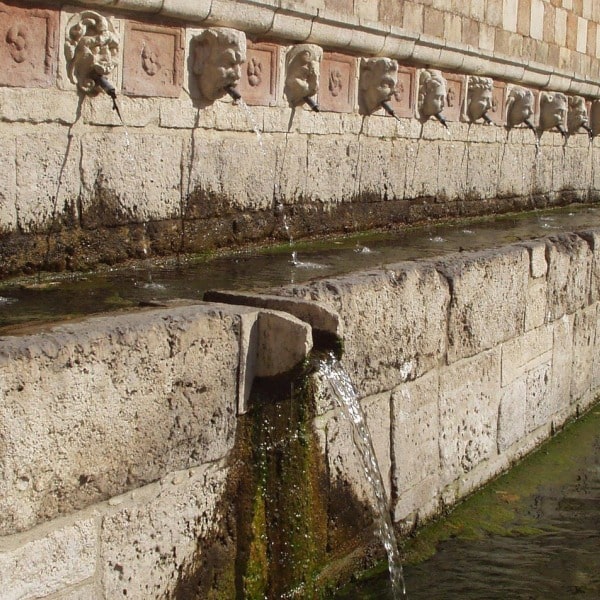
L’Aquila was founded in the 13th century as a confederation of 99 villages — a fact commemorated in the Fontana delle 99 Cannelle, the medieval fountain whose 99 carved faces each represent one of the founding villages and whose restoration has been one of the most symbolically important projects of the reconstruction. The city grew to become one of the most significant in the medieval Kingdom of Naples, its position at 714 meters above sea level giving it a cool mountain climate and a commanding position over the surrounding valleys that made it both defensible and commercially significant. The churches and palaces that expressed this significance — the Basilica di Santa Maria di Collemaggio, with its remarkable pink and white stone facade; the Palazzo Margherita; the church of San Bernardino — are being restored to their pre-earthquake condition with a precision and care that reflects both Italian expertise in historic preservation and the city’s determination to recover its identity. Many are already reopened; others remain behind scaffolding for years yet.
The Reconstruction as Experience
What makes visiting L’Aquila genuinely unlike any other destination in Italy is the experience of moving through a city that is simultaneously a historic treasure and an active construction site. The centro storico — gradually reopening street by street as buildings are certified safe — is populated by a community that has returned to live and work in the spaces they left after the earthquake, surrounded by the evidence of what was lost and what is being recovered. The temporary wooden structures that replaced damaged buildings in the immediate aftermath of the earthquake are themselves being replaced by restored or rebuilt originals; the orange scaffolding that has become the visual signature of the city is slowly coming down. Walking through this process — understanding what each building was, what happened to it, and what it will be again — gives the visit a dimension that no conventional city tour can provide.
The Gran Sasso and the Mountain Setting
L’Aquila sits at the foot of the Gran Sasso massif and is the closest major town to the highest peaks of the Apennines. The cable car from the city to Campo Imperatore — the high-altitude plateau below the Corno Grande — is one of the most dramatic mountain ascents in central Italy, and the combination of a morning in the city and an afternoon on the plateau covers the full range of what this part of Abruzzo offers. The Abruzzo countryside that surrounds L’Aquila on every side connects the city into a broader regional itinerary that takes in the national parks, the hill towns, and the Adriatic coast.
L’Aquila on an Abruzzo Self-Drive
A visit to L’Aquila fits naturally into a self-guided tour of Abruzzo that combines the city with trekking in the National Park and the Trabocchi Coast. Explore the full Abruzzo region to plan your itinerary, then contact our team to start building your trip, or learn more about how a self-guided tour works.
To provide the best experiences, we and our partners use technologies like cookies to store and/or access device information. Consenting to these technologies will allow us and our partners to process personal data such as browsing behavior or unique IDs on this site and show (non-) personalized ads. Not consenting or withdrawing consent, may adversely affect certain features and functions.
Click below to consent to the above or make granular choices. Your choices will be applied to this site only. You can change your settings at any time, including withdrawing your consent, by using the toggles on the Cookie Policy, or by clicking on the manage consent button at the bottom of the screen.