
Visit Capri Island: The Place That Seduced Emperors and Artists
To visit Capri Island is to arrive at one of the most celebrated destinations in the Mediterranean — a small limestone rock in the Bay of Naples whose reputation for beauty has been continuous since the Emperor Augustus first saw it from a passing ship and immediately negotiated its acquisition from the city of Naples. Tiberius, his successor, went further — he moved the imperial court to Capri and governed the empire from the island for the last decade of his life, building twelve villas across its rocky terrain.The island that seduced two Roman emperors has since done the same to an uninterrupted succession of writers, painters, musicians, and travelers who arrived intending to stay a day and remained for years. Capri is small — roughly ten square kilometers — and consistently crowded in the summer months, but its combination of dramatic limestone cliffs, crystal-clear water, terraced gardens, and the particular atmosphere of a place that has been famous for two thousand years without becoming ordinary makes it one of the most compelling destinations in the entire Mediterranean.
The Blue Grotto: Light and Water
The Grotta Azzurra — the Blue Grotto — is a sea cave on the northwestern coast of Capri, accessible only by small rowing boat through a low entrance that requires passengers to lie flat in the boat as it passes through. Inside the cave, the light enters not through the entrance above water but through a submerged opening below, and the refraction of that light through the water fills the cave with an intense blue luminosity that turns everything within it — the water, the boat, the hands of the oarsman — the same extraordinary color. The experience lasts only a few minutes before the boat exits back into the daylight, but the quality of the light inside is unlike anything available anywhere else on the island and unlike anything most visitors have seen before. Access depends on sea conditions — even moderate swell makes entry through the low entrance impossible — which means the Blue Grotto is not guaranteed on any given day and worth treating as a priority on arrival.
Capri Town and the Piazzetta
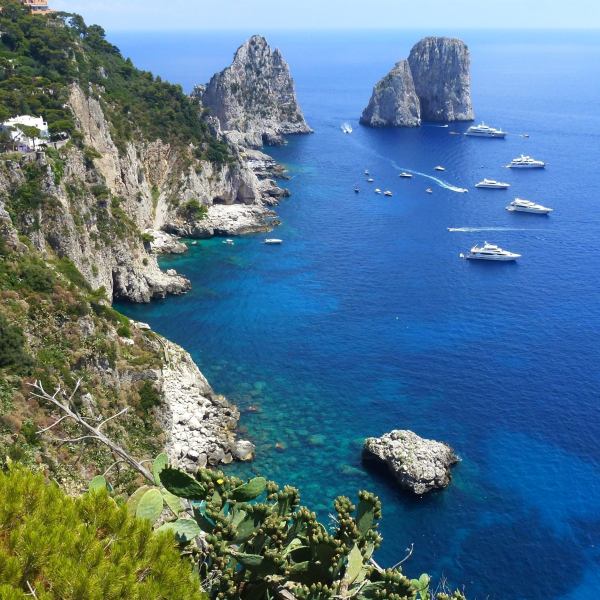
The town of Capri, reached from the Marina Grande by funicular or by road, is organized around the Piazzetta — the Piazza Umberto I, a small square of cafés, boutiques, and the clock tower of the church of Santo Stefano that functions as the social center of the island and one of the most celebrated people-watching spots in Italy. The streets that radiate from the Piazzetta lead through a compact historic center of whitewashed houses and bougainvillea-draped walls toward the Gardens of Augustus, a series of terraced gardens with views over the Faraglioni — the three limestone stacks that rise from the sea off the southern coast and have become the symbol of the island — and down toward the Marina Piccola below.
Anacapri: The Quieter Village
Anacapri, the second town of the island, sits on the higher plateau to the west and is reached by a narrow road of hairpin bends from the town below or by the chairlift from the main road that climbs to the summit of Monte Solaro — at 589 meters, the highest point on the island, with views extending on clear days from Vesuvius and the Cilento coast to the mainland mountains of Calabria in the far south. Anacapri is quieter and less glossy than Capri town, its streets more residential in character and its atmosphere more genuinely Campanian. The Villa San Michele, built by the Swedish physician Axel Munthe in the early 20th century on the ruins of one of Tiberius’s villas, is the most visited site in Anacapri — its gardens, loggia, and collection of Roman sculpture forming one of the most personal and romantic historic houses open to visitors anywhere in southern Italy.
Capri on a Campania Self-Drive
Capri is reached by hydrofoil or ferry from Naples, Sorrento, or Positano, and fits naturally into a self-guided tour of Campania that combines the island with a walking tour of Naples, the Amalfi Coast, and Pompeii and Vesuvius. Explore the full Campania region to plan your itinerary, then contact our team to start building your trip, or learn more about how a self-guided tour works.
To provide the best experiences, we and our partners use technologies like cookies to store and/or access device information. Consenting to these technologies will allow us and our partners to process personal data such as browsing behavior or unique IDs on this site and show (non-) personalized ads. Not consenting or withdrawing consent, may adversely affect certain features and functions.
Click below to consent to the above or make granular choices. Your choices will be applied to this site only. You can change your settings at any time, including withdrawing your consent, by using the toggles on the Cookie Policy, or by clicking on the manage consent button at the bottom of the screen.