
Aquileia UNESCO Archaeological Site: Rome’s Forgotten Capital
The Aquileia UNESCO archaeological site is one of the most significant and least-visited Roman sites in Italy — a small, quiet town in the Friuli plain between Trieste and Venice that was, at the height of its power in the 2nd and 3rd centuries AD, the fourth-largest city in the Roman Empire and the primary military and commercial hub of the entire northeastern frontier. Founded in 181 BC as a Latin colony, Aquileia grew rapidly into a city of perhaps 100,000 inhabitants, its position at the head of the Adriatic making it the natural gateway between Italy and the provinces of Pannonia, Noricum, and Dalmatia beyond. The archaeological remains of that city — forum, port, basilica, mosaics, necropolis — earned UNESCO World Heritage status in 1998 and represent one of the finest concentrations of Roman material culture anywhere in the Mediterranean world.
The Basilica and the Mosaic Floor
The most immediately extraordinary sight in Aquileia is neither Roman nor ancient in the conventional sense — it is the mosaic floor of the early Christian basilica, laid in the early 4th century under Bishop Theodore and preserved beneath the present Romanesque cathedral in a state of remarkable completeness. The floor covers approximately 760 square meters and depicts a rich iconographic program of early Christian symbols, narrative scenes, and portrait figures that represents the largest surviving early Christian mosaic in the Western world. The images — fish, birds, the story of Jonah, portrait busts in medallions — are executed with a technical skill and a freshness of color that the intervening seventeen centuries have not diminished. Walking above them on the raised walkways installed for visitor access, with the Romanesque pillars of the cathedral rising above and the original Roman floor level visible below, is one of the most moving archaeological experiences in Italy.
The Roman Town and the Museum
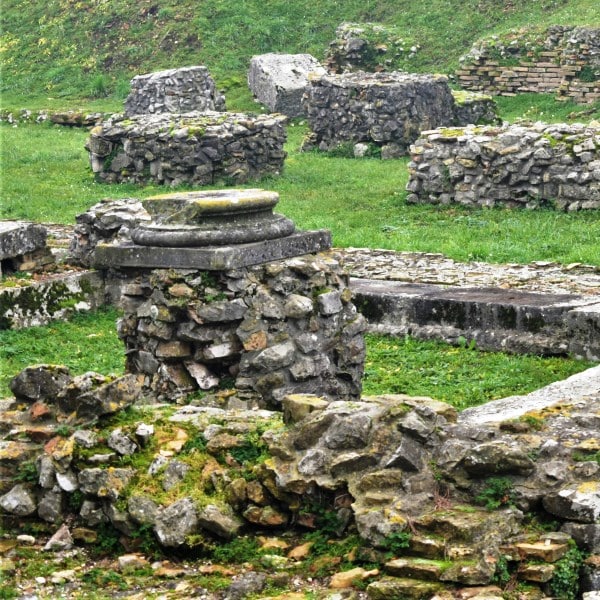
The archaeological area that surrounds the basilica preserves the remains of the Roman forum, the port canal, and sections of the road network that connected Aquileia to the rest of the empire. The port canal — the Natissa river, canalized by the Romans to allow sea-going vessels to reach the city directly — is still visible as a green channel running through the archaeological park, its banks lined with the stone bases of warehouses and commercial buildings that handled the trade goods flowing in and out of the northeastern provinces. The Museo Archeologico Nazionale di Aquileia houses the finds from two centuries of excavation — portrait sculpture, glass, amber, coins, jewelry, and everyday objects of extraordinary quality that give a vivid picture of daily life in one of the Roman world’s great cities.
Aquileia and the Surrounding Lagoon
The landscape around Aquileia is as historically resonant as the town itself. The lagoon of Grado — the shallow coastal lagoon that separates the Friuli plain from the open Adriatic — was the refuge to which the population of Aquileia fled when Attila sacked the city in 452 AD, and the island of Grado became the seat of the patriarchate that had made Aquileia the most important ecclesiastical center in the northern Adriatic. The drive from Aquileia to Grado — a short causeway across the lagoon — connects the Roman archaeological site with a medieval island town of considerable beauty, its basilicas preserving further mosaic floors and the memory of the patriarchal city that grew from the ashes of the Roman one.
Aquileia on a Friuli Venezia Giulia Self-Drive
The Aquileia UNESCO archaeological site connects naturally into a self-guided tour of Friuli Venezia Giulia that combines the Roman ruins with a day in Trieste to the east and the wine country of Collio and the Friuli hills to the north. Explore the full Friuli Venezia Giulia region to see how Aquileia fits into a complete regional itinerary, then contact our team to start planning, or learn more about how a self-guided tour works.
To provide the best experiences, we and our partners use technologies like cookies to store and/or access device information. Consenting to these technologies will allow us and our partners to process personal data such as browsing behavior or unique IDs on this site and show (non-) personalized ads. Not consenting or withdrawing consent, may adversely affect certain features and functions.
Click below to consent to the above or make granular choices. Your choices will be applied to this site only. You can change your settings at any time, including withdrawing your consent, by using the toggles on the Cookie Policy, or by clicking on the manage consent button at the bottom of the screen.