
Trieste Coffee Coast and Charm: Italy’s Most Central European City
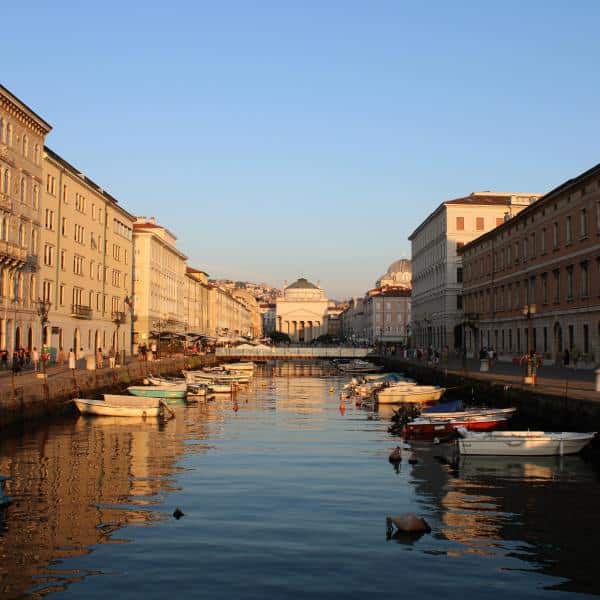
Trieste coffee, coast, and charm define a city that stands apart from every other destination in Italy — a port city at the northeastern tip of the country where the Adriatic meets the Karst plateau, where the architecture is Habsburg rather than Italian Baroque, and where the café culture is so deeply embedded in daily life that even the vocabulary for ordering coffee is different from the rest of the country. Trieste was for centuries the main seaport of the Austro-Hungarian Empire, and the wealth and the cosmopolitan character that came with that role are still visible in the grand neoclassical piazzas, the Liberty-style palaces, and the literary history of a city that attracted James Joyce, Italo Svevo, Rainer Maria Rilke, and Richard Burton — not the actor, but the Victorian explorer who translated the Arabian Nights here. A day in Trieste is a day in an Italy that is unlike any other.
The Coffee Culture
Trieste has the highest per capita coffee consumption of any city in Italy, and its café culture has developed over two centuries into something genuinely distinct. The vocabulary alone signals the difference: ordering a “caffè” in Trieste produces a puzzled look — the correct term is “nero” for an espresso, “capo” for a macchiato, “capo in B” for a macchiato in a glass. The historic cafés of the city — the Caffè San Marco, opened in 1914 and still preserving its original Liberty interior of mirrors, wood paneling, and marble; the Caffè degli Specchi on the Piazza Unità d’Italia — were the gathering places of the city’s literary and intellectual life for generations and remain central to the daily rhythm of the city. Coffee in Trieste is not a transaction but a ritual, and the cafés that serve it are among the most beautiful in Europe.
The Piazza Unità d’Italia and the Waterfront
The Piazza Unità d’Italia is the largest sea-facing piazza in Italy — an enormous neoclassical square that opens directly onto the harbor on one side and is enclosed on the other three by the Palazzo del Municipio, the Palazzo del Lloyd Triestino, and the Palazzo della Prefettura, all built in the late 19th and early 20th centuries in a style that owes more to Vienna than to Rome. The square is the formal heart of the city and the starting point for a walk along the Riva waterfront — the long seafront promenade that extends in both directions from the piazza, with views across the Gulf of Trieste toward the Istrian peninsula on clear days. The Molo Audace, a long pier extending into the harbor from the Piazza Unità, is where the citizens of Trieste walk in the evening, particularly when the Bora — the powerful northeast wind that is as much a part of the city’s identity as the coffee — is not blowing.
The Karst and the Coast
Above the city, the Carso — the limestone plateau that rises steeply from the coastal plain — is one of the most unusual natural landscapes in northeastern Italy: a treeless, wind-scoured terrain of sinkholes, caves, and dry stone walls that gives way inland to forests and vineyards producing the local Terrano wine. The road that climbs from Trieste to the plateau offers one of the finest views of the city and the gulf below, and the villages of the Carso — Opicina, Monrupino, Rupinpiccolo — are worth the short detour for the combination of landscape, food, and the particular atmosphere of a territory that feels simultaneously Italian and Slovenian. The coast south of Trieste, toward the Miramare promontory where the Habsburg Archduke Maximilian built his white castle directly on the sea, is one of the most scenic coastal drives in the region.
Trieste on a Friuli Venezia Giulia Self-Drive
Trieste is the natural gateway to a self-guided tour of Friuli Venezia Giulia — a region that extends northwest through the wine country of Collio and the Friuli plains toward Udine and the Dolomite foothills. The Friuli Venezia Giulia region is one of Italy’s most undervisited and most rewarding, and Trieste makes a compelling starting point for those arriving by road from Venice or from Slovenia. Contact our team to start planning, or learn more about how a self-guided tour works.
To provide the best experiences, we and our partners use technologies like cookies to store and/or access device information. Consenting to these technologies will allow us and our partners to process personal data such as browsing behavior or unique IDs on this site and show (non-) personalized ads. Not consenting or withdrawing consent, may adversely affect certain features and functions.
Click below to consent to the above or make granular choices. Your choices will be applied to this site only. You can change your settings at any time, including withdrawing your consent, by using the toggles on the Cookie Policy, or by clicking on the manage consent button at the bottom of the screen.