
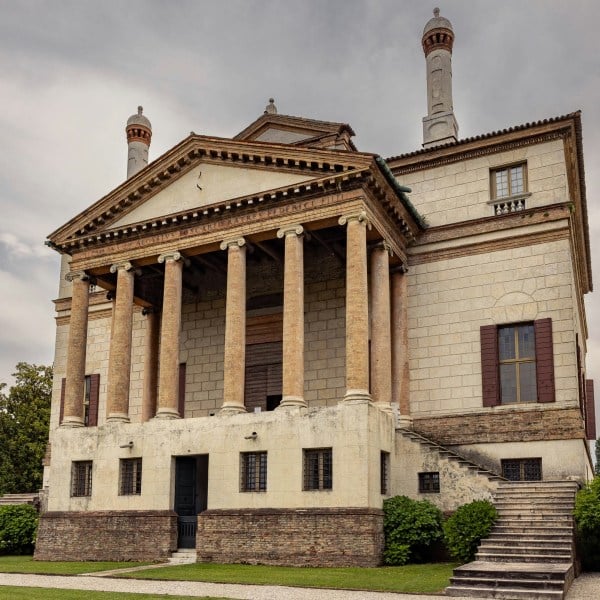
Andrea Palladio built villas in the Veneto countryside for sixteenth-century Venetian nobles who wanted a retreat from the city. What he created went far beyond that. His buildings — balanced, luminous, rooted in classical proportion but entirely original — became the most influential architectural language in history. The White House, the country estates of England, the plantation houses of the American South, the public buildings of capitals across the world — all of them trace their lineage back to a handful of villas scattered across the hills and plains between Vicenza and the Brenta canal.
Driving through the Veneto to visit these buildings is one of the great cultural experiences in Italy. They appear at the end of gravel roads, on the edge of small towns, framed by vineyards and cypress trees — and every one of them has the power to stop you in your tracks. The harmony of their facades, the intelligence of their floor plans, the way they sit in the landscape as if they grew there — Palladio understood something about beauty that still resonates five centuries later.
Vicenza itself is Palladio’s masterpiece as a city. The Basilica Palladiana dominates Piazza dei Signori with its double arcade of white stone. The Teatro Olimpico — the oldest surviving indoor theatre in the world — has a stage set that creates the illusion of infinite depth, a trick of perspective that still astonishes every visitor who walks in. The streets around them are lined with palazzi that Palladio designed for Vicenza’s noble families, each one a lesson in proportion and grace.
Beyond the city, the villas spread across the Veneto countryside. Villa Rotonda, perhaps the most famous private residence ever built, sits on a hilltop south of Vicenza — four identical facades, four flights of steps, a perfect dome. Villa Barbaro in Maser holds frescoes by Veronese that are among the finest of the Renaissance. Villa Emo, Villa Foscari, Villa Pisani — each one is different, each one is extraordinary, and each one is set in a landscape that makes the drive between them a pleasure in itself.
This is an experience that was made for a self-drive tour. The villas are scattered across the Veneto countryside, connected by quiet roads that wind through vineyards, olive groves, and small towns where life has barely changed since Palladio’s time. You cannot see them by train. A bus tour rushes you through. But with a car, you arrive at each villa on your own terms, take the time it deserves, and let the landscape between them become part of the experience.
Italy Trails designs this journey as part of a wider self-drive tour of Northern Italy — combining Palladian architecture with Venice, Verona, the Prosecco hills, or the Dolomites. We select the accommodation, plan the route between villas, and make sure you see not just the famous names but the ones that most visitors miss entirely.
See how our self-drive tours work, or contact us to include the Palladian villas in your Italian journey.
To provide the best experiences, we and our partners use technologies like cookies to store and/or access device information. Consenting to these technologies will allow us and our partners to process personal data such as browsing behavior or unique IDs on this site and show (non-) personalized ads. Not consenting or withdrawing consent, may adversely affect certain features and functions.
Click below to consent to the above or make granular choices. Your choices will be applied to this site only. You can change your settings at any time, including withdrawing your consent, by using the toggles on the Cookie Policy, or by clicking on the manage consent button at the bottom of the screen.