Ravenna Mosaic: The Greatest Byzantine Art in the Western World
The Ravenna mosaic tradition is the most extraordinary concentration of early Christian and Byzantine art in the Western world — a city whose eight UNESCO World Heritage Sites contain mosaics of such quality, variety, and state of preservation that no other location in Europe or the Mediterranean comes close to matching them. Ravenna was, for over a century and a half, one of the most important cities in the late Roman and early medieval world: capital of the Western Roman Empire from 402 AD, then of the Ostrogothic kingdom under Theodoric, then of the Byzantine Exarchate from 540 AD — a succession of rulers who each left their mark in gold and glass tesserae on the walls and vaults of the city’s churches and mausoleums. A day in Ravenna is a day in a city that looks modest from the outside and reveals, behind its brick facades, some of the most dazzling interior spaces ever created.
The Basilica of San Vitale and the Mausoleum of Galla Placidia
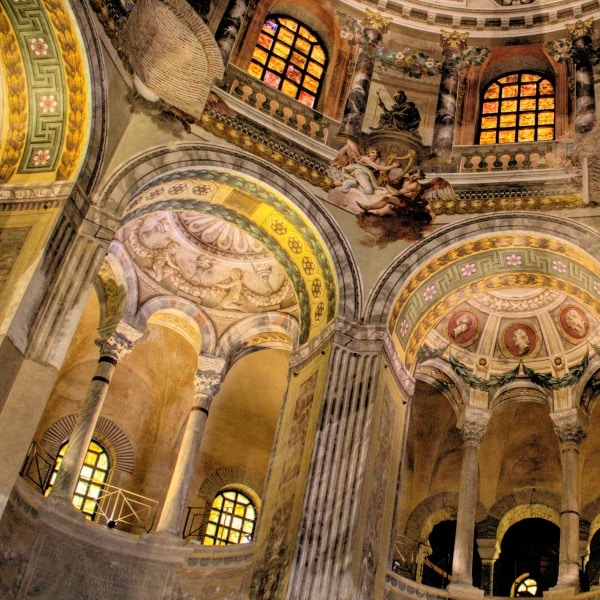
The Basilica of San Vitale, consecrated in 547 AD under the Byzantine Emperor Justinian, contains the mosaics that most visitors come to Ravenna specifically to see — and that most leave feeling they were not adequately prepared for. The apse mosaic depicts Justinian and his empress Theodora in formal procession, their faces rendered with a directness and psychological presence that belies the stylization of the Byzantine tradition. The surrounding vaults and lunettes are covered in a continuous program of Old and New Testament scenes, symbolic imagery, and architectural decoration that fills every surface of the octagonal interior with color and light. Immediately adjacent, the Mausoleum of Galla Placidia is the oldest of Ravenna’s UNESCO sites and perhaps the most intimate — a small cross-shaped building whose interior is covered in a deep blue mosaic sky pierced by gold stars, the color and atmosphere of the space unlike anything else in Italy.
The Basilica of Sant’Apollinare Nuovo and Sant’Apollinare in Classe
The Basilica of Sant’Apollinare Nuovo, built by Theodoric in the early 6th century, contains two long processions of mosaic figures running the length of the nave — twenty-two virgins on one side, twenty-six martyrs on the other — that represent the most complete example of narrative mosaic decoration from the Ostrogothic period. The figures move with a stately, rhythmic repetition that is simultaneously formal and hypnotic, their gold backgrounds flickering in the light from the nave windows. Sant’Apollinare in Classe, five kilometers outside the city in the former port district, is the most monumental of Ravenna’s basilicas — a vast early Christian church whose apse mosaic, depicting Sant’Apollinare among symbolic sheep in a stylized landscape, achieves a grandeur and serenity that the smaller city churches approach but never quite match.
The City Beyond the Mosaics
Ravenna rewards those who look beyond the UNESCO circuit. The Tomb of Dante — who died here in 1321 after his exile from Florence and is buried in a small neoclassical mausoleum adjacent to the church of San Francesco — draws literary pilgrims from across the world. The Piazza del Popolo, the main square, is a graceful Renaissance space of considerable charm. The city’s food culture reflects its position between the Adriatic and the Po delta — fish, eels from the Valle Comacchio, and the piadina flatbread that is the signature street food of the entire Romagna.
Ravenna on an Emilia-Romagna Self-Drive
Ravenna sits on the Adriatic edge of Emilia-Romagna and connects naturally into a self-guided tour that combines the mosaics with Bologna food culture and the Ferrari experience in Maranello. Explore the full Emilia-Romagna region to plan your itinerary, then contact our team to start building your trip, or learn more about how a self-guided tour works.