Bologna Food Culture: La Grassa, La Dotta, La Rossa
Bologna food culture is the reason most travelers come here, and the reason they stay longer than planned. The city has been known as La Grassa — the fat one — for centuries, a nickname that reflects not gluttony but abundance: a culinary tradition of extraordinary richness built on the finest raw ingredients in Italy and a cooking style that has influenced kitchens across the world without ever needing to leave Emilia-Romagna. Tagliatelle al ragù, tortellini in brodo, mortadella, Parmigiano Reggiano, prosciutto di Parma — the dishes and ingredients that define Italian food internationally were largely invented or perfected within a few kilometers of Bologna’s two towers. But the city is more than its food: La Dotta — the learned one — is home to the oldest university in the Western world, and La Rossa — the red one — refers both to the terracotta color of its medieval rooftops and to its long tradition of left-wing politics.
The Quadrilatero and the Markets
The historic market quarter of Bologna — the Quadrilatero, a grid of medieval streets between Piazza Maggiore and Via Rizzoli — is the best place to encounter Bologna food culture at its most direct and unmediated. The streets are lined with salumerias, cheese shops, pasta shops, and fishmongers that have occupied the same locations for generations, their displays of mortadella, culatello, aged Parmigiano, and fresh egg pasta representing the accumulated expertise of a food culture that takes its ingredients with absolute seriousness. The covered market of the Mercato delle Erbe, a short walk from the Quadrilatero, is more working-class in character — a large iron-and-glass hall from the early 20th century where the residents of the surrounding neighborhoods shop for produce, fish, and prepared foods alongside the growing number of visitors who have discovered that eating at the market counters is consistently better value and often better quality than the restaurants outside.
The Porticoes and the Architecture
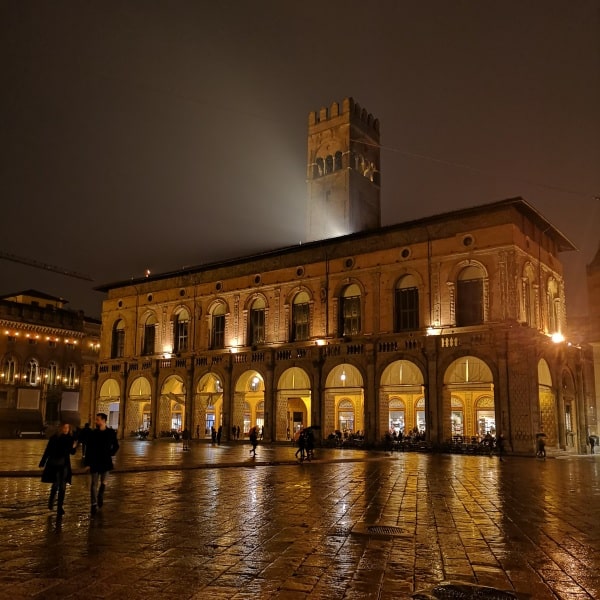
Bologna’s 40 kilometers of covered walkways — the porticoes that line the streets of the historic center and extend up the hill to the Sanctuary of San Luca — were inscribed as a UNESCO World Heritage Site in 2021, a recognition of an architectural tradition that has been continuous in the city since the medieval period and that defines the experience of walking through Bologna in every season. The porticoes keep the summer sun off the pavement, shelter pedestrians from the winter rain, and create a series of framed views along the streets that give the city its particular visual character. The Basilica of San Petronio in Piazza Maggiore — one of the largest churches in the world, never completed — and the two towers of the Asinelli and Garisenda in Piazza di Porta Ravegnana anchor the historic center architecturally and provide the most recognizable silhouette on the Bologna skyline.
The University and the City’s Intellectual Life
The University of Bologna was founded in 1088 — the oldest in the Western world by any reasonable measure — and its presence has shaped the character of the city for nearly a thousand years. The student population gives Bologna an energy and a social life that persists year-round, its bars, bookshops, and music venues serving a community that uses the city differently from the tourists who pass through it. The Archiginnasio, the university’s original palazzo in the historic center, houses an anatomical theatre of the 17th century — a tiered wooden room decorated with carved figures and coats of arms — and a library of extraordinary richness that is open to visitors.
Bologna on an Emilia-Romagna Self-Drive
Bologna food culture connects naturally into a self-guided tour of Emilia-Romagna that extends along the Via Emilia toward Parma, Modena, and Ferrara — each city adding its own chapter to the food story of the region. Explore the full Emilia-Romagna region to see how Bologna fits into a broader itinerary, then contact our team to start planning, or learn more about how a self-guided tour works.