
A City Built on Genius
Florence is one of those cities where the weight of what happened here is still palpable in the streets. The Renaissance was not an abstract historical period — it was a specific eruption of talent, money, and ambition concentrated in a relatively small city over a few generations, and its physical evidence is still standing, still accessible, still capable of stopping people mid-stride. At the center of that story, for many visitors, is Michelangelo. He was born in the Tuscan hills, trained in Florence under the patronage of Lorenzo de’ Medici, and returned to the city repeatedly throughout a career that lasted nearly seven decades. His work is woven into the fabric of the city in ways that a single visit can only begin to trace.
The David: Presence Over Reproduction
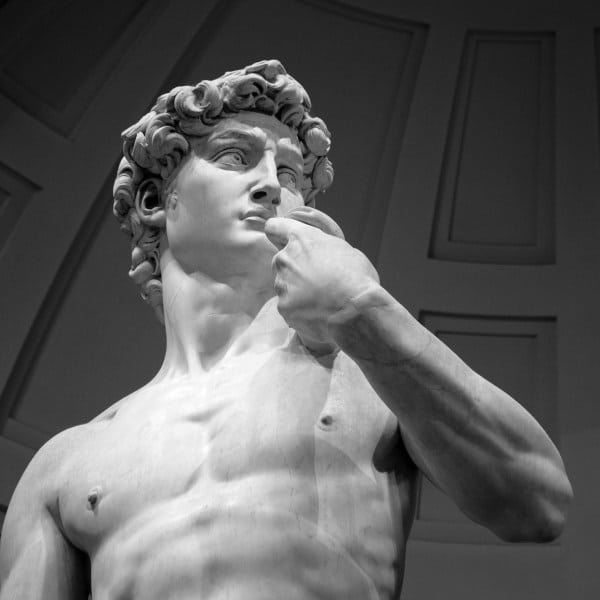
The Galleria dell’Accademia houses the original David, and the experience of seeing it in person is genuinely different from any reproduction. Michelangelo carved the sculpture between 1501 and 1504 from a single block of Carrara marble that two previous sculptors had abandoned as unworkable — too tall, too narrow, structurally compromised. What he produced from that material stands over five meters high, every anatomical detail resolved with a precision that remains extraordinary more than five centuries later. The Accademia also holds his unfinished Prisoners, a series of figures that appear to be struggling out of the stone rather than carved from it. These incomplete works offer something the David cannot: a direct window into the artist’s process, the marks of the chisel still visible, the figures caught between intention and form.
Michelangelo’s Florence Beyond the Accademia
The Medici Chapels at San Lorenzo contain the New Sacristy, where Michelangelo designed both the architecture and the tomb sculptures — Dawn, Dusk, Day, and Night — that represent some of the most emotionally resonant work of his career. The figures recline on the curved lids of the sarcophagi with a restless, uncomfortable energy that feels entirely deliberate. The Bargello, one of Florence’s most undervisited major museums, holds Michelangelo’s Bacchus and Brutus alongside an early David in bronze by Donatello, making it the best place in the city to understand how Florentine sculpture evolved across generations. The Casa Buonarroti, the family home Michelangelo purchased later in life and which he never actually lived in, preserves early relief carvings and a collection of drawings that trace the full arc of his development as an artist.
Florence in the Wider Landscape of Tuscany
Florence works best as part of a broader itinerary rather than a destination in isolation. The city sits at the northern edge of a Tuscan landscape that extends south through the Chianti hills, past Siena and San Gimignano, and into the Val d’Orcia — all of it accessible by road at your own pace. The neighborhoods across the Arno, the hill town of Fiesole above the city, and the drive south through the Chianti vineyards all reward those who build time into the itinerary rather than filling every hour. Explore the full Tuscany region to see how Florence connects with the countryside around it.
Italy Trails in Florence
Italy Trails builds Florence into Tuscan self-drive itineraries that give the city the space it deserves — with accommodation chosen for location and character, routes that connect the city to the surrounding hills and towns, and local recommendations that go beyond the standard list. Contact our team to start planning, or learn more about how a self-guided tour works.
To provide the best experiences, we and our partners use technologies like cookies to store and/or access device information. Consenting to these technologies will allow us and our partners to process personal data such as browsing behavior or unique IDs on this site and show (non-) personalized ads. Not consenting or withdrawing consent, may adversely affect certain features and functions.
Click below to consent to the above or make granular choices. Your choices will be applied to this site only. You can change your settings at any time, including withdrawing your consent, by using the toggles on the Cookie Policy, or by clicking on the manage consent button at the bottom of the screen.