
Trulli of Alberobello: A UNESCO Landscape Unlike Any Other in Italy
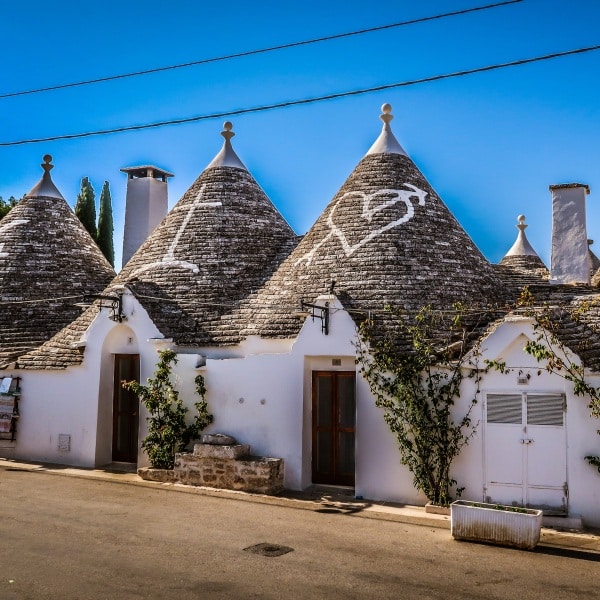
The trulli of Alberobello are the most recognizable architectural feature of Puglia and one of the most immediately distinctive building types in all of Italy — circular dry-stone constructions with conical roofs of stacked limestone slabs, their whitewashed walls bright against the terracotta-red soil of the Valle d’Itria, their grey stone roofs painted with ancient symbols whose meanings are debated and whose visual effect is entirely unique. Alberobello, the town in the province of Bari where the trulli are most densely concentrated, has been a UNESCO World Heritage Site since 1996, and the Rione Monti quarter — a hillside of over 1,500 trulli visible from a single viewpoint — is the most complete surviving example of this building tradition anywhere in the world. Arriving in Alberobello for the first time, the landscape seems almost implausible — too consistent, too perfectly composed to be the unplanned result of centuries of incremental construction. It is entirely real, and entirely extraordinary.
The Architecture: How a Trullo is Built
A trullo is constructed without mortar — the limestone slabs of the walls and the conical roof are laid dry, each course slightly smaller than the one below, the whole structure held together by gravity and the precision of the stacking. The technique allowed the buildings to be dismantled rapidly in the event of a tax inspection by the Neapolitan authorities, who levied duties on permanent structures — a practical origin for an architectural form that has become one of the most celebrated in the Mediterranean. The interior of a trullo is a single circular room, cool in summer and warm in winter by virtue of the thermal mass of the stone walls and the insulating properties of the conical roof. The symbols painted on the exterior of the cones — crosses, spirals, primitive figures — were added by the inhabitants as protective talismans, their precise origins combining Christian, pagan, and astrological references that no single interpretive framework fully accounts for.
Alberobello: The Town and Its Two Quarters
The town of Alberobello divides broadly into two trulli districts. The Rione Monti, on the hillside to the west of the main road, is the larger and more visited — a dense concentration of trulli lining narrow lanes that descend toward the valley, the majority now converted into tourist shops, restaurants, and accommodation. The Rione Aia Piccola, on the opposite hillside to the east, is smaller, less commercial, and more genuinely residential in character — a quarter where many of the trulli are still lived in by families rather than converted for tourism, and where the atmosphere is considerably quieter and more authentic. The Trullo Sovrano, in the center of the town, is the only two-story trullo in existence — a structure of unusual scale and ambition that now houses a small museum documenting the history of the building tradition.
The Valle d’Itria: Locorotondo, Cisternino, and Ostuni
The trulli of Alberobello are the most famous expression of a broader landscape that extends across the Valle d’Itria — the valley between Bari and Taranto whose combination of trulli farmhouses, masserie, olive groves, and limestone hills constitutes one of the finest rural landscapes in southern Italy. The towns that ring the valley — Locorotondo, with its circular historic center of white houses and geranium-filled balconies; Cisternino, quieter and less visited; Ostuni, the white city on its hilltop above the coastal plain — each offer a different dimension of the same landscape and reward the self-drive traveler who takes the secondary roads between them rather than the main highway.
Alberobello on a Puglia Self-Drive
The trulli of Alberobello sit at the center of a Puglia itinerary that connects north toward Bari street food and south toward Lecce and the magical Salento. Explore the full Apulia region to plan your itinerary on a self-guided tour of Puglia, then contact our team to start building your trip, or learn more about how a self-guided tour works.
To provide the best experiences, we and our partners use technologies like cookies to store and/or access device information. Consenting to these technologies will allow us and our partners to process personal data such as browsing behavior or unique IDs on this site and show (non-) personalized ads. Not consenting or withdrawing consent, may adversely affect certain features and functions.
Click below to consent to the above or make granular choices. Your choices will be applied to this site only. You can change your settings at any time, including withdrawing your consent, by using the toggles on the Cookie Policy, or by clicking on the manage consent button at the bottom of the screen.