
Camogli and San Fruttuoso: The Ligurian Coast at Its Most Authentic
Camogli and San Fruttuoso together offer one of the most complete day trips on the Italian Riviera — a combination of a fishing town of extraordinary pictorial character and a medieval abbey on a sheltered cove accessible only by boat or on foot, set within the protected landscape of the Portofino Promontory Regional Park. Camogli is one of the most photographed villages on the Ligurian coast for good reason: its tall, painted houses rise directly from the sea wall in a stack of terracotta and ochre and faded yellow that photographers have been trying to capture adequately for a century, without ever quite succeeding. San Fruttuoso, twenty minutes by boat from Camogli’s harbor, belongs to a different category of Ligurian experience entirely — a place that the landscape itself seems to have kept hidden, tucked into a narrow cove between wooded headlands where no road has ever reached and where the only sounds are the sea and the wind in the trees above.
Camogli: The Village of a Thousand White Sails
Camogli takes its name from a contraction of casa delle mogli — houses of the wives — a reference to the tradition of the town’s men spending most of the year at sea while the women managed the village and the fishing operations onshore. At its 19th-century peak, Camogli was one of the most important seafaring communities in the Mediterranean, its fleet of sailing ships trading across the Atlantic and the Indian Ocean from a harbor that today launches ferries and fishing boats rather than merchant vessels. The tall houses that line the seafront were built to the height they are because land was scarce and families large — five or six stories of painted plaster rising directly from the harbor wall, their facades decorated with trompe l’oeil architectural details that create the impression of columns, cornices, and balustrades where the underlying structure is plain flat wall. The effect, seen from the sea on a morning arrival by ferry, is one of the most striking townscapes in Italy.
San Fruttuoso: The Hidden Abbey
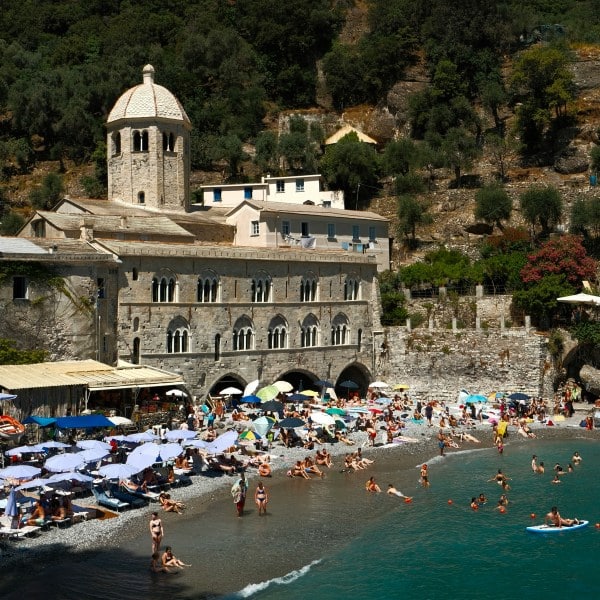
The Abbey of San Fruttuoso di Camogli occupies a cove on the southern flank of the Portofino Promontory that is surrounded on three sides by wooded hillside and open on the fourth to the sea. The abbey was founded in the 10th century by Benedictine monks and rebuilt in the 13th century by the Doria family, whose tombs are preserved in the church interior — an intimate Romanesque space of considerable beauty whose arches and columns are visible from the small beach in front of the building. The complex is owned by the FAI — the Italian National Trust — and is one of the most unusual historic sites in Liguria: reachable only by the boat from Camogli or Portofino, or by a hiking trail through the park that takes between one and two hours depending on the starting point. The beach in front of the abbey is small and pebbled, the water clear, and the combination of medieval architecture and natural cove creates an atmosphere that is entirely unlike anything available on the more accessible stretches of the Ligurian coast. Offshore, at a depth of seventeen meters, stands the Cristo degli Abissi — a bronze statue of Christ submerged in 1954 as a votive offering to the sea, visible to divers and snorkelers and commemorated by a replica on the abbey terrace above.
The Portofino Promontory and the Park
The regional park that protects the Portofino Promontory — the headland between the Gulf of Tigullio and the Gulf of Paradiso on which both Camogli and San Fruttuoso sit — covers approximately 1,000 hectares of land and a significant area of protected marine habitat offshore. The landscape of the park is Mediterranean macchia and holm oak forest interrupted by the occasional clearing with views over the sea, and the network of hiking trails that crosses it connects Camogli, San Fruttuoso, Portofino, and Santa Margherita Ligure in a series of routes that range from easy coastal walks to more demanding ridge traverses. The park’s marine reserve, which extends from San Fruttuoso to Portofino, is one of the most carefully managed in Italy, and the combination of clear water and protected seabed makes it among the finest snorkeling and diving destinations on the Ligurian coast.
Camogli and San Fruttuoso on a Liguria Self-Drive
A day trip to Camogli and San Fruttuoso fits naturally into a self-guided tour of Liguria that can combine the Portofino Promontory with the Cinque Terre to the west, Genoa to the north, and the inland valleys of the Ligurian Apennines. The drive along the eastern Riviera — the Riviera di Levante — passes through a succession of coastal towns and headlands that make the journey between stops as rewarding as the destinations themselves. Explore the full Liguria region to see how Camogli and San Fruttuoso connect with the broader landscape of one of Italy’s most scenically concentrated coastlines.
Italy Trails at Camogli and San Fruttuoso
Italy Trails builds a day trip to Camogli and San Fruttuoso into Ligurian self-drive itineraries with ferry connections from Camogli to San Fruttuoso arranged in advance, accommodation selected in Camogli or on the eastern Riviera, and routes that connect the Portofino Promontory with the rest of the coast. Contact our team to start planning, or learn more about how a self-guided tour works.
To provide the best experiences, we and our partners use technologies like cookies to store and/or access device information. Consenting to these technologies will allow us and our partners to process personal data such as browsing behavior or unique IDs on this site and show (non-) personalized ads. Not consenting or withdrawing consent, may adversely affect certain features and functions.
Click below to consent to the above or make granular choices. Your choices will be applied to this site only. You can change your settings at any time, including withdrawing your consent, by using the toggles on the Cookie Policy, or by clicking on the manage consent button at the bottom of the screen.