
Abruzzo tours are not for the traveller who wants to see what everyone else has already seen. They are for the person who has visited Rome, explored Tuscany, driven the Amalfi Coast — and is now looking for the Italy that exists beyond the guidebooks. The Italy where wolves still roam through mountain forests. Where medieval villages sit on ridges so high they disappear into the clouds. Where the coastline has wooden fishing platforms that have not changed in three hundred years. Where the food is fierce, honest, and made from ingredients that were gathered that morning.
This is Abruzzo — the region that sits between Rome and the Adriatic, barely two hours from either, and yet feels like a different country entirely. It is the wildest region in central Italy, with one-third of its territory protected as national parks and nature reserves. It is also one of the least visited by international tourists, which means that when you arrive, you arrive into something real.
Why Abruzzo Tours Are the Best-Kept Secret in Italian Travel
The question that most travellers ask when they first hear about Abruzzo is simple: why haven’t I heard of this place before? The answer is equally simple: because Abruzzo has never needed to market itself. It has no fashion industry like Milan, no art industry like Florence, no film industry like Rome. It has mountains, wolves, shepherds, castles, and a way of life that has continued, largely undisturbed, for centuries. The people who know Abruzzo — Italian hikers, wildlife photographers, food writers — tend to keep it to themselves.
But the secret is getting out. Abruzzo tours are growing in popularity among experienced travellers who have already seen the famous destinations and want something deeper. What they find is a region of extraordinary variety: the highest peaks of the Apennines, a pristine Adriatic coastline, medieval hill towns that rival anything in Umbria or Tuscany, and a food culture that is among the most authentic in Italy.
What You Will Discover on an Abruzzo Tour
The Mountains: Gran Sasso and Majella
Abruzzo is the most mountainous region in central Italy, and the Gran Sasso d’Italia — at 2,912 metres the highest peak in the Apennines — dominates the landscape with a presence that is felt from every direction. The massif contains the southernmost glacier in Europe (Campo Imperatore) and a high plateau known as “Little Tibet” — a vast, treeless expanse of grassland at 1,800 metres that is unlike anything else in Italy. The drive up to Campo Imperatore, through gorges and alpine meadows, is one of the most dramatic road experiences in the country.
The Majella massif, to the south, is wilder and less visited. Its slopes are covered with beech forests that shelter deer, chamois, and the occasional Marsican brown bear — one of the rarest mammals in Europe, with a population of only about sixty individuals. The hermitages carved into the rock faces of the Majella — where medieval monks lived in isolation for decades — are among the most extraordinary and least-known monuments in Italy.
The National Parks: Where the Wolves Are
Abruzzo is home to three national parks and one regional park, making it one of the greenest and most protected regions in Europe. The Parco Nazionale d’Abruzzo, Lazio e Molise is the oldest and most famous: established in 1922, it is the place where the Apennine wolf, the Marsican brown bear, and the Abruzzo chamois were saved from extinction. Today, the park’s forests and mountain valleys are home to one of the most successful rewilding stories in Europe.
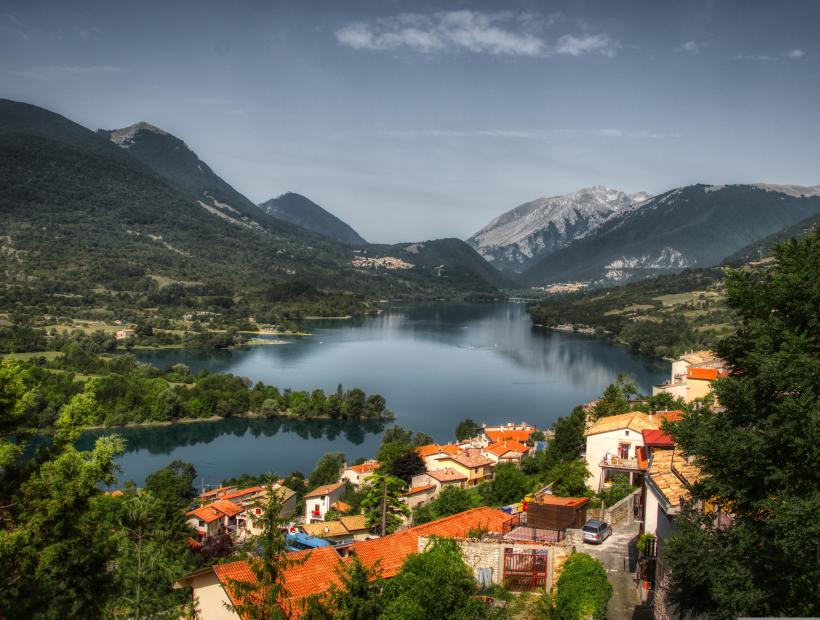
For the traveller on an Abruzzo tour, the parks offer something rare: the chance to drive through genuine wilderness within a few hours of Rome. The roads that cross the parks — through the Sangro valley, over the Passo del Diavolo, along the shores of Lake Scanno — are among the most beautiful and least-trafficked in Italy. You drive for an hour and see no other car. You stop at a viewpoint and hear nothing but wind and birdsong. This is not a park you visit — it is one you drive through, slowly, with the windows down.
The Hill Towns
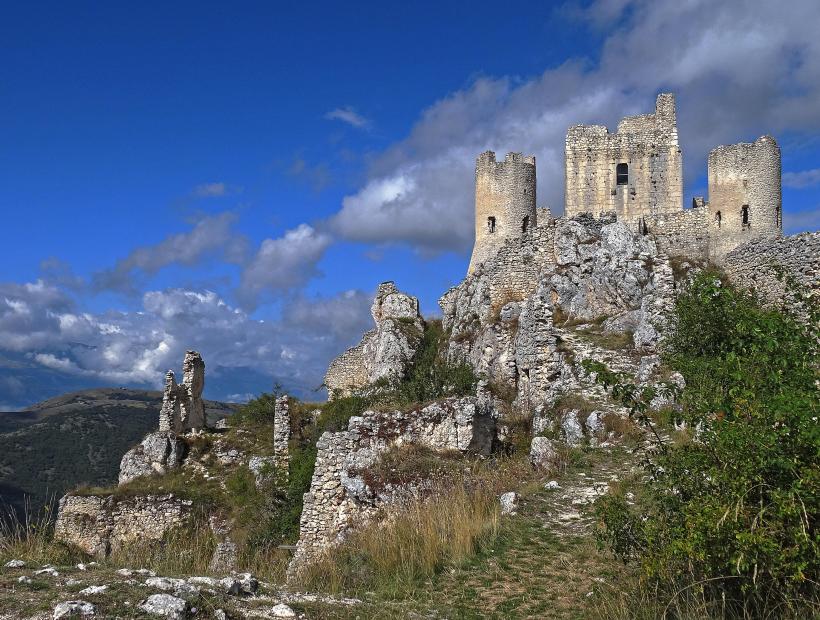
Abruzzo’s medieval hill towns are among the most dramatic in Italy — perched on ridges and mountain spurs, built from local stone, and largely unchanged since the Middle Ages. Santo Stefano di Sessanio, a beautifully restored Medici-era village at the edge of the Gran Sasso, has become a model for sustainable tourism in Italy — its old houses converted into a “albergo diffuso” (scattered hotel) that preserves the fabric of the village. Scanno, in the Sagittario valley, has an old town of extraordinary beauty and a tradition of goldwork jewellery that dates back centuries. Pescocostanzo, at 1,400 metres, has Renaissance churches and ironwork that would be famous if it were in Tuscany. And Rocca Calascio — a ruined fortress at 1,460 metres, the highest castle in the Apennines — offers views that stretch from the Adriatic to the mountains and was used as the setting for the film Ladyhawke.
The Costa dei Trabocchi
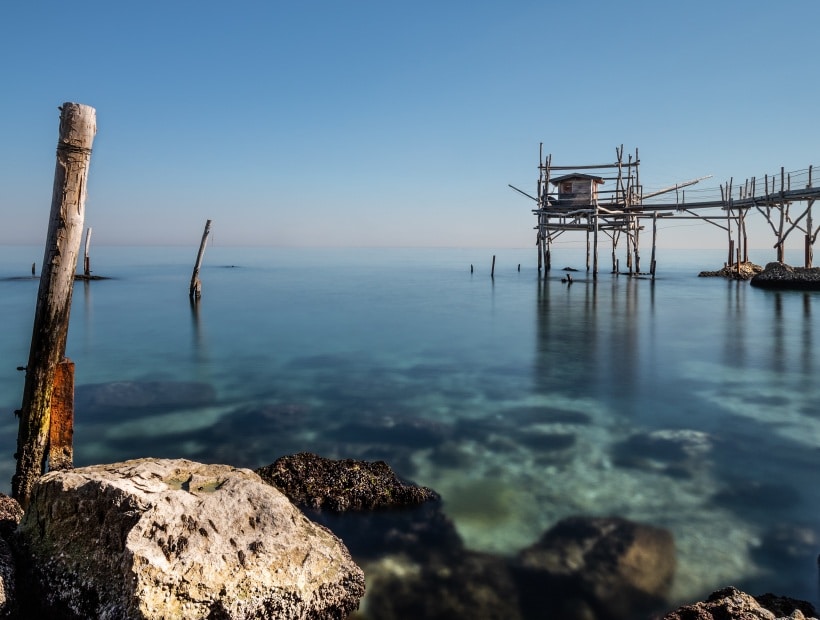
Abruzzo’s Adriatic coastline is one of the most distinctive in Italy. The Costa dei Trabocchi — named for the trabocchi, ancient wooden fishing platforms that jut out over the sea on stilts — stretches for fifty kilometres between Ortona and Vasto. Many of these trabocchi have been converted into restaurants where the seafood is cooked a few metres from where it was caught, and the sound of the waves is part of the meal. The coast itself alternates between sandy beaches and rocky coves, with a cycling and walking path that follows the old railway line along the shore. Driving the coast road in the late afternoon, with the trabocchi silhouetted against the sunset and the Majella visible in the background, is one of those moments that defines an Italian journey.
Sulmona and the Confetti
Sulmona, the birthplace of the Roman poet Ovid, is one of the most elegant small cities in Abruzzo. Set in a valley surrounded by mountains, it has a medieval aqueduct, a Renaissance piazza, and a tradition of confetti (sugar-coated almonds) that has been the heart of the local economy since the fifteenth century. The confetti shops of the Corso Ovidio, with their elaborate flower arrangements made entirely from sugared almonds, are unique in Italy. Sulmona is also the gateway to the Majella and the Peligna valley — a landscape of vineyards, olive groves, and villages where the local Montepulciano d’Abruzzo wine is made.
The Food: Why Abruzzo Tours Are Also Food Tours
Abruzzo’s cuisine is one of the most underrated in Italy, and for the traveller who cares about food, it alone justifies the journey. Arrosticini — small skewers of lamb, grilled over charcoal and eaten by the dozen — are the region’s signature dish, cooked at every roadside grill and mountain restaurant. Maccheroni alla chitarra — square-cut pasta made on a wire frame, served with lamb ragù — is one of the great pasta dishes of southern Italy. Pallotte cacio e ova — fried cheese and egg balls in tomato sauce — is the kind of cucina povera that makes you wonder why anyone would eat anything more complicated.
And the wine. Montepulciano d’Abruzzo — not to be confused with the Tuscan town — is one of Italy’s most popular and most misunderstood reds. At its commercial level, it is the house wine of a thousand pizzerias. At its best — made by small producers in the hills of Loreto Aprutino or the Ofena valley — it is a wine of remarkable depth and complexity, and one of the best values in Italian wine. Trebbiano d’Abruzzo, the local white, and Cerasuolo, the rosato, complete a trio that makes any Abruzzo tour a wine tour as well.
The Best Time for Abruzzo Tours
Late spring (May–June) is the finest season. The mountains are green, the wildflowers on the Gran Sasso and in the national parks are extraordinary, and the coast is warm and uncrowded. The hill towns are at their most atmospheric.
Autumn (September–October) brings the harvest, golden light, and truffle season. The mountains are stunning in autumn colour, and the food is at its annual best.
Summer (July–August) is ideal for the coast and the high mountains. Campo Imperatore and the Majella are cool when the lowlands are hot. The Costa dei Trabocchi restaurants are at their liveliest.
Winter offers excellent skiing at Roccaraso and Campo Imperatore, snow-covered villages of extraordinary beauty, and an Abruzzo that belongs entirely to itself.
Why a Self-Drive Tour Is the Only Way to See Abruzzo
There is no train to Santo Stefano di Sessanio. No bus to Rocca Calascio. No scheduled transport to the trabocchi restaurants or the hermitages of the Majella or the shores of Lake Scanno. Abruzzo is a region where the most extraordinary things are at the end of roads that only a car can travel.
This is why a self-drive tour is not just the best way to experience Abruzzo — it is the only way to connect the mountains, the coast, the hill towns, and the national parks in a journey that makes sense. The roads themselves are the reward: empty, winding, climbing through landscapes that change every twenty minutes, with nobody ahead of you and nobody behind.
Why Choose Italy Trails for Your Abruzzo Tour
Italy Trails designs personalised Abruzzo tours that go beyond the obvious — combining the national parks with the Costa dei Trabocchi, the mountain villages with Sulmona and the wine country, the famous and the completely unknown. We select accommodation that fits the terrain: an albergo diffuso in Santo Stefano di Sessanio, a masseria in the Majella foothills, a small hotel on the coast overlooking the trabocchi.
Every detail is handled — the route, the stops, the restaurant recommendations, and a smartphone with navigation and direct support from our team in English. See how our self-drive tours work.
Abruzzo combines naturally with Molise, Puglia and Lazio for a wider central Italy journey that takes you from Rome into the wildest and most authentic part of the peninsula.