
Tre Cime di Lavaredo: The Most Iconic Peaks in the Dolomites
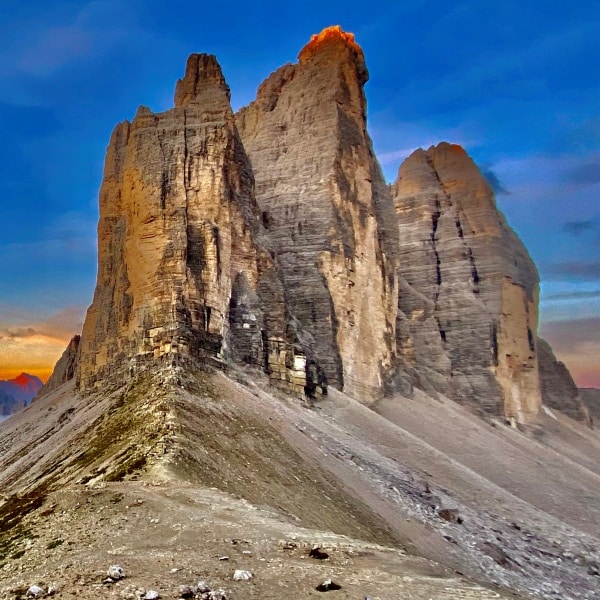
The Tre Cime di Lavaredo are the most recognizable rock formation in the Dolomites, and among the most photographed mountains in the world. Three vertical towers of pale limestone — the Cima Piccola, the Cima Grande, and the Cima Occidentale — rise from the plateau of the Sesto Dolomites at nearly 3,000 meters, their north faces dropping almost sheer for 500 meters into the cirque below. There is no gradual approach, no gentle reveal. The Tre Cime di Lavaredo appear suddenly, fully formed, as you come over the ridge from the south, and the effect is immediate: a landscape that looks constructed rather than geological, as if the rock had been placed deliberately to produce exactly this impression of scale and verticality.
A Landscape Shaped by History and Geology
The Tre Cime di Lavaredo sit on what was, during the First World War, the front line between the Italian and Austro-Hungarian armies. The surrounding plateau is still marked by the remains of that conflict — tunnels cut into the rock, fortified positions on the ridgelines, cemeteries in the valleys below. The geology that made these towers so dramatic also made them strategically important: the high ground here controlled movement through the Sesto valley and the passes leading north toward Austria. Walking the circuit around the base of the Tre Cime today, visitors pass through a landscape that is simultaneously one of the most beautiful in Italy and one of the most historically charged. The two things are inseparable here.
The Circuit and the Rifugi
The classic route around the Tre Cime di Lavaredo is a circular walk of approximately ten kilometers, accessible from the Rifugio Auronzo, which sits at 2,320 meters and can be reached by a toll road from Misurina. The circuit takes between three and four hours at a comfortable pace and offers continuously changing views of the three towers as well as the surrounding Sesto Dolomites — the Cadini di Misurina to the south, the Cristallo massif to the west, and the austere north faces of the Tre Cime themselves as you round the eastern side of the formation. The Rifugio Lavaredo and the Rifugio Locatelli, positioned at different points along the route, provide shelter, food, and the particular atmosphere of alpine mountain huts that operate at altitude and attract a mix of serious climbers and casual walkers in roughly equal measure.
The Drive to Misurina and the Sesto Dolomites
The approach to the Tre Cime di Lavaredo is itself worth the journey. The road from Cortina d’Ampezzo to Misurina passes through some of the most spectacular Dolomite scenery in the Veneto, and Lake Misurina — a small alpine lake at the foot of the Sorapiss massif — is one of the finest viewpoints in the eastern Dolomites. The toll road from Misurina to the Rifugio Auronzo climbs through a series of switchbacks with views that expand with every hairpin. This is exactly the kind of driving that suits a self-guided tour of northern Italy — roads that justify the journey independently of the destination, through a landscape that the Trentino-Alto Adige region offers in greater concentration than anywhere else in Italy.
Combining Tre Cime with the Broader Dolomites
The Tre Cime di Lavaredo sit at the eastern end of a Dolomite circuit that can extend west through the Val Gardena, the Alpe di Siusi, and the passes of the Trentino-Alto Adige self-drive into a complete alpine itinerary. Cortina d’Ampezzo, twenty minutes to the south, provides the most comfortable base in the area — a resort town with serious mountain infrastructure and a setting that makes it one of the most scenically positioned towns in Italy.
Italy Trails at Tre Cime di Lavaredo
Italy Trails builds the Tre Cime di Lavaredo into Dolomite itineraries with accommodation selected in Cortina or Misurina, approach routes mapped from wherever you are in northern Italy, and the local detail that makes the difference between a good alpine day and an exceptional one. Contact our team to start planning, or learn more about how a self-guided tour works.
To provide the best experiences, we and our partners use technologies like cookies to store and/or access device information. Consenting to these technologies will allow us and our partners to process personal data such as browsing behavior or unique IDs on this site and show (non-) personalized ads. Not consenting or withdrawing consent, may adversely affect certain features and functions.
Click below to consent to the above or make granular choices. Your choices will be applied to this site only. You can change your settings at any time, including withdrawing your consent, by using the toggles on the Cookie Policy, or by clicking on the manage consent button at the bottom of the screen.