
The Capuchin Catacombs of Palermo are a place where death is not hidden. It is not sealed inside coffins, not covered by marble slabs, not consigned to a cemetery on the outskirts of town. It is right there, an arm’s length from your face, hanging from the walls, dressed in its Sunday best, and it is looking at you.
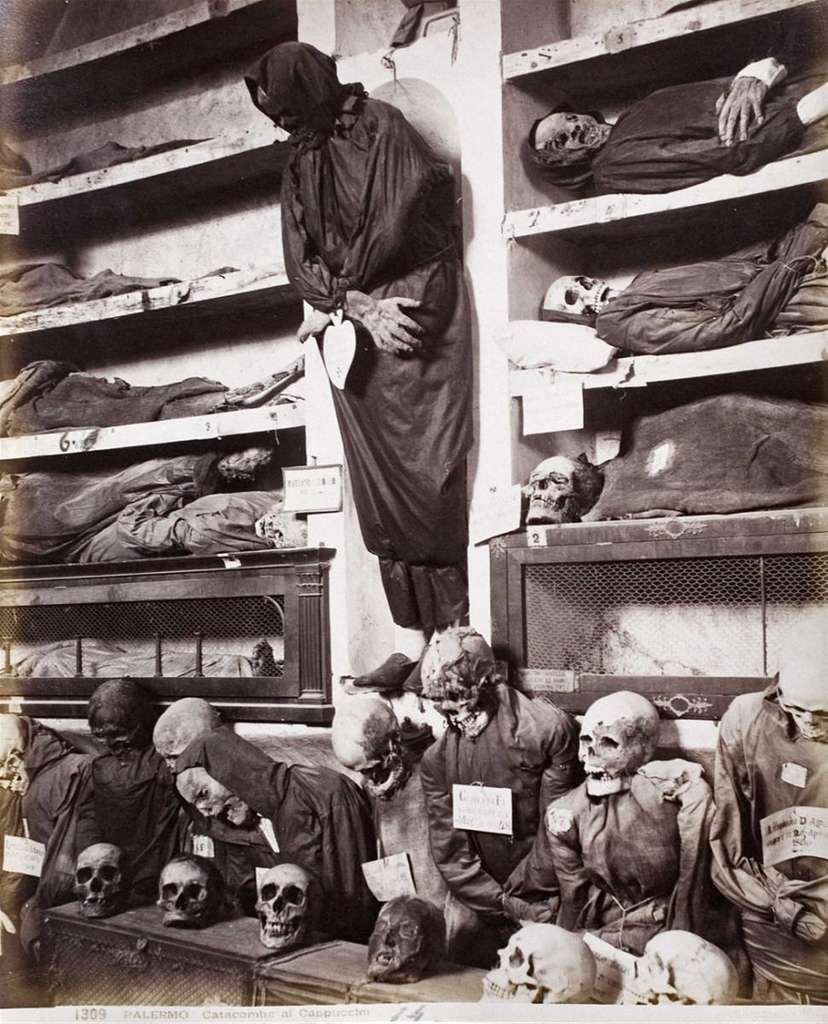
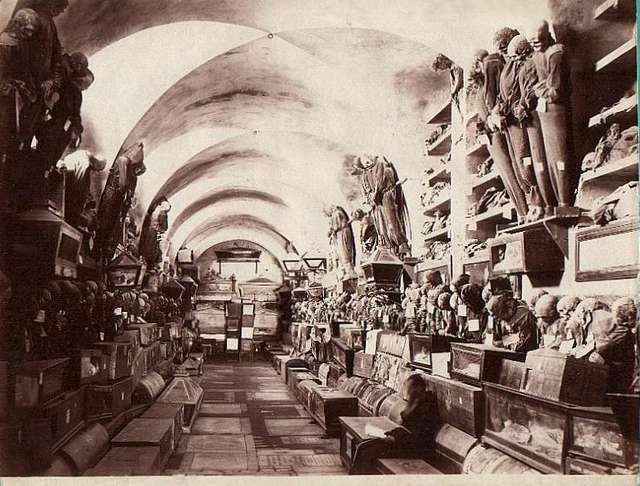
The Capuchin Catacombs lie beneath the friary attached to the Church of Santa Maria della Pace, in the Cuba quarter. They are not catacombs in the Roman sense — they are not early Christian underground worship spaces carved from tufa. They are a cemetery. A vertical cemetery, where the dead do not lie down but stand upright, lined along damp and silent corridors, sorted by sex, by profession, by social rank, like guests at a reception that has been going on for four centuries.
And it is there, at the end of the last corridor, inside a sealed glass case, that a two-year-old girl sleeps. She looks like she is napping. She has golden curls held back by a yellow ribbon, cheeks that still seem soft, eyes closed with the serenity of someone having a quiet dream. She died in 1920. Her name is Rosalia Lombardo, and the people of Palermo call her the Sleeping Beauty.
How a Cemetery of Dressed Ghosts Was Born
It all began by accident. In 1599, during expansion work on the friary, the Capuchin monks discovered that several brethren buried in the underground chambers had mummified naturally, thanks to the unusual temperature and humidity conditions of the subsoil. The first body found intact was that of Brother Silvestro da Gubbio, interred on October 16th of that year.
Word spread quickly, and with it came a request the friars had not anticipated: Palermo’s nobility wanted to be buried there. Not underground, sealed in a box. Displayed. Visible. Dressed. Recognisable. They wanted their families to be able to come back and visit them, to look them in the face, to speak to them as if they were still alive. In return, they offered generous donations to the friary.
The Capuchins agreed, and within a few decades the underground space had transformed into something without parallel anywhere in the world. The friars perfected a method of natural mummification: bodies were desiccated in special chambers called colatoi for approximately eight months, then washed with vinegar, dressed in their finest clothes, and placed along the corridor walls, inside niches or suspended from hooks. Some were laid in open coffins, halfway between sleep and exhibition.
From the seventeenth to the nineteenth century, thousands of people — monks, aristocrats, professionals, soldiers, women, children — chose this form of burial. Today the catacombs hold approximately 8,000 bodies. Eight thousand people who never left.
The Corridors of the Living
Descending into the catacombs is an experience you do not forget. Not because of the horror — or not only because of it — but because of the strange sense of intimacy that develops between you and the dead. They are not anonymous. They have clothes, postures, expressions. Some appear to smile. Others have their mouths frozen open in a silent scream that has lasted for centuries.
The corridors are organised according to a logic that mirrors the social structure of Palermo at the time. There is the corridor of the priests, the corridor of the professionals, the corridor of the soldiers. There is the gallery of the women, many of whom still wear their best clothes — silks, lace, embroidered bonnets — faded by time but still recognisable. And there is the corridor of the children, the hardest to walk through: rows of small bodies dressed as if for a party, with ribbons in their hair and little shoes on their feet, silent witnesses to an era when infant mortality was the norm and almost every family mourned at least one child.
The catacombs were an obligatory stop on the Grand Tour. Guy de Maupassant visited and wrote about them. Travellers from all over Europe descended into those corridors with the same morbid curiosity and reverential awe that visitors feel today. There is something profoundly Palermitan about this unfiltered, face-to-face relationship with death: no euphemisms, no distance, no pretence. The dead are there, and you are there with them.
Alfredo Salafia and the Lost Formula
The cemetery was officially closed in 1880. From that point on, in theory, no more bodies could be admitted. But rules, in Palermo, have always had a certain flexibility.
In 1911, an exception was made for Giovanni Paterniti, the Vice Consul of the United States. And in December 1920, another exception was made — the last one ever — for a girl who had not yet turned two.
Rosalia Lombardo was born on December 13th, 1918, into a well-to-do Palermo family. She died on December 6th, 1920, of pneumonia — one of the countless victims of the Spanish Flu and its aftermath. Her father, Mario Lombardo, was devastated. He refused to accept the idea that his daughter’s body would disappear into the earth. He wanted to see her still. He wanted her to remain.
He turned to Alfredo Salafia, a Palermitan embalmer who had spent years perfecting an innovative method of preserving human remains. Salafia had already worked on illustrious figures — Cardinal Michelangelo Celesia, the statesman Francesco Crispi, the ethnologist Giuseppe Pitrè. But little Rosalia would become his masterpiece.
Salafia performed a single intravascular injection using a formula of his own invention: formalin, glycerin, zinc salts, alcohol, and salicylic acid. To the face he added a treatment of paraffin dissolved in ether, to keep the cheeks soft and the appearance of a living child. Then he placed the girl in a coffin with a glass lid and entrusted her to the Capuchins.
Salafia died in 1933, taking his secret with him. For decades, no one could replicate the result. The formula was believed lost forever, until the Messina-born palaeopathologist Dario Piombino-Mascali, after eight years of research, managed to track down the original manuscript through Anna, Salafia’s great-granddaughter. Thirty handwritten pages, titled Nuovo Metodo Speciale per la conservazione del cadavere umano intero allo stato permanentemente fresco — “New Special Method for the Preservation of the Entire Human Cadaver in a Permanently Fresh State.” The title alone is a poem.
The Girl Who Opens Her Eyes
There is a detail that has fuelled legends for decades. Some visitors, over the years, have sworn that Rosalia opens and closes her eyes. The eyelids seem to move almost imperceptibly, as if the child is about to wake up.
The explanation, provided by the scientists who have studied the mummy with CT scans and X-rays, is less miraculous but no less fascinating: it is an optical illusion caused by the light filtering through the crypt’s windows and by the slight change in angle as the visitor’s gaze meets the child’s face. The eyelids are not fully closed — they reveal a hint of blue iris, intact after more than a century. As the light shifts, the illusion of movement is inevitable.
But try explaining that to a Palermitan. Rosalia opens her eyes, full stop. And perhaps, in a way, he’s right.
Why the Capuchin Catacombs of Palermo Are Not a House of Horrors
It would be easy to dismiss the Capuchin Catacombs as a macabre attraction, a thrill-seeker’s curiosity for tourists looking for a scare. That would be a mistake.
What you breathe in those corridors is something far more complex: it is the relationship that an entire city has built with its dead over the course of centuries. A relationship made of proximity, of care, of conversation. Palermitan families used to descend into the catacombs regularly to change their loved ones’ clothes, to tidy their hair, to pray in front of them as you might pray in front of a relative sitting in an armchair. Death, here, was not a rupture. It was a different form of presence.
It is the same spirit that animates the Fontanelle Cemetery in Naples, another extraordinary expression of southern Italy’s relationship with the dead. It is the same spirit that runs through the Day of the Dead in Sicily, when children receive gifts from deceased family members. It is a southern Italy that has never accepted the idea that death is the end of the relationship.
If places like this fascinate you, if you are looking for an Italy that goes beyond the postcards, Italy Trails offers self-guided itineraries that reach the most unexpected corners of Sicily — where history is not in museums, but in the stones, in the underground, in the faces.
Visiting the Capuchin Catacombs of Palermo
The Capuchin Catacombs are located at Piazza Cappuccini 1, in the Cuba quarter of Palermo, a few minutes’ walk from the Palazzo dei Normanni. They are open daily. A visit takes around forty minutes, but it is worth allowing yourself more. This is not a place to rush through.
Rosalia Lombardo’s chapel is at the end of the first corridor. The child is now preserved in a sealed, nitrogen-saturated case that ensures her conservation. Photography is not permitted, but you will not need it: once you have seen that face, you will not forget it.
Palermo is a city that keeps its secrets underground — beneath the churches, beneath the palaces, beneath the noisy, vital crust of the surface. The catacombs are perhaps the most powerful of these secrets. To explore Sicily with different eyes, take a look at the itineraries on Italy Trails.
Eight thousand bodies dressed for a celebration. Four centuries of dead who will not leave. And a girl with golden curls who, for a hundred and six years, has looked as though she is about to open her eyes and ask where everyone has gone.
Discover the Sicily You Didn’t Expect
From Palermo’s underground to Agrigento’s temples, from hidden hill towns to wild coastlines — Sicily reveals itself to those who dare to leave the path. Explore at your own pace with Italy Trails.