
Padua Famous Chapel: The Scrovegni and the Birth of Western Art
Padua’s famous chapel — the Cappella degli Scrovegni — is one of the most important buildings in the history of Western art, and one of the few sites in Italy that genuinely deserves the word unmissable. Completed in 1305, the chapel was decorated entirely by Giotto di Bondone with a cycle of frescoes depicting the lives of the Virgin and of Christ that marked a fundamental break with the Byzantine tradition that had dominated European painting for centuries. Giotto’s figures have weight, emotion, and spatial presence — they occupy a believable world rather than a gold-ground abstraction. Standing inside the chapel, surrounded on every wall and on the vault above by this cycle of images, is to be present at one of the defining moments in the history of human visual culture. Architecture lovers who visit Padua for the Scrovegni alone will find themselves staying longer than planned.
The Chapel in Context: Giotto’s Achievement
The Scrovegni Chapel was commissioned by Enrico Scrovegni as an act of penance — his father, a notorious moneylender, had been placed by Dante in the Inferno. The building is a simple barrel-vaulted nave with no side aisles, designed to serve as a frame for Giotto’s paintings rather than as an architectural statement in its own right. The frescoes are organized in three registers running around the walls, with the Last Judgment covering the entrance wall and the vault painted as a night sky of deep lapis lazuli blue punctuated by gold stars. The figures throughout the cycle are depicted with a consistency of psychological observation that was entirely new in European painting: the grief of the mourners in the Lamentation, the tenderness of the Nativity, the theatricality of the Kiss of Judas. Visiting the chapel requires a timed reservation and is limited to small groups for conservation reasons, which means the experience retains an intimacy that the scale of the achievement might otherwise overwhelm.
Padua Beyond the Scrovegni: A City of Architecture
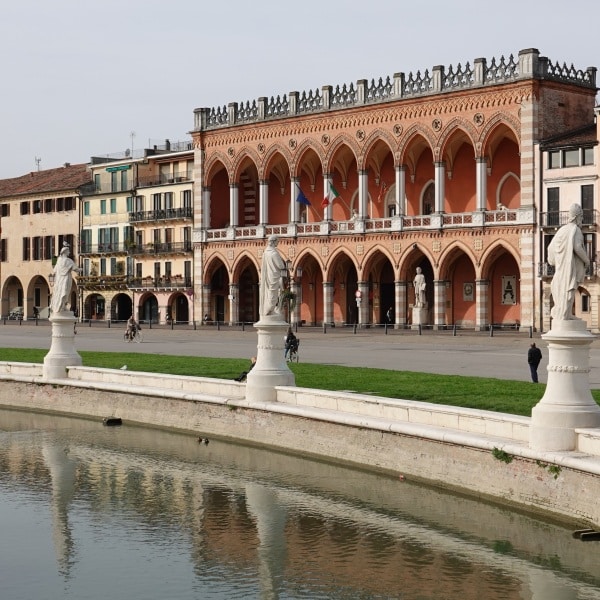
The Scrovegni is the most famous of Padua’s architectural treasures, but the city rewards those who explore beyond it. The Basilica di Sant’Antonio — universally known simply as Il Santo — is one of the great pilgrimage churches of Italy, a complex of Romanesque and Gothic forms topped by Byzantine domes that dominates the southern end of the old city. Its interior contains bronze reliefs by Donatello and a sequence of chapels decorated with frescoes, ex-votos, and reliquaries that represent the accumulated devotion of seven centuries. The Prato della Valle, the elliptical square that sits behind the basilica, is the largest public square in Italy — an island of green surrounded by a canal and lined with 78 statues of illustrious Paduans, a 18th-century urban composition on a scale that few Italian cities attempted. The Palazzo della Ragione, the medieval town hall that dominates the central market squares, contains the largest undivided medieval hall in Italy — a single room of extraordinary scale frescoed with an astrological and calendar cycle.
The University and the Botanical Garden
Padua is also a university city of ancient standing — the University of Padua was founded in 1222, making it one of the oldest in the world. The anatomical theatre inside the university’s historic palazzo, built in 1595, is the oldest surviving anatomy theatre in the world: a steep wooden oval that could accommodate 300 observers watching dissections performed at the table below. The Orto Botanico di Padova, founded in 1545 and a UNESCO World Heritage Site, is the oldest academic botanical garden in the world still in its original location, and contains specimens — including a palm tree planted in 1585 that Goethe visited in 1786 — that connect the history of European science with a living collection of extraordinary botanical diversity.
Padua on a Veneto Self-Drive
Padua sits at the center of a Veneto itinerary that can extend in any direction — west toward Verona and Lake Garda, east toward Venice, north into the Euganean Hills and the Dolomite foothills. It connects naturally into a self-guided tour of northern Italy that uses the cities of the Veneto as anchors and the surrounding landscape as connective tissue. Explore the full Veneto region to see how Padua fits into a broader itinerary across one of Italy’s richest cultural landscapes.
Italy Trails in Padua
Italy Trails builds Padua into Veneto self-drive itineraries with accommodation selected in the historic center, Scrovegni Chapel reservations arranged in advance, and routes that connect the city with the surrounding landscape and the other great towns of the region. Contact our team to start planning, or learn more about how a self-guided tour works.
To provide the best experiences, we and our partners use technologies like cookies to store and/or access device information. Consenting to these technologies will allow us and our partners to process personal data such as browsing behavior or unique IDs on this site and show (non-) personalized ads. Not consenting or withdrawing consent, may adversely affect certain features and functions.
Click below to consent to the above or make granular choices. Your choices will be applied to this site only. You can change your settings at any time, including withdrawing your consent, by using the toggles on the Cookie Policy, or by clicking on the manage consent button at the bottom of the screen.