
Arzachena Nuragic Heritage: Prehistory at the Edge of the Costa Smeralda
The Arzachena nuragic heritage is one of the best-kept secrets of northeastern Sardinia — a concentration of prehistoric monuments scattered across the granite hills just a few kilometers from the famous beaches of the Costa Smeralda, in a landscape that most visitors drive through without stopping. The municipality of Arzachena contains one of the highest densities of nuragic and pre-nuragic sites in the entire island: giants’ tombs, sacred wells, stone circles, and nuraghi that date back between 2,000 and 4,000 years and represent the accumulated architectural ambition of a civilization that left no written records but an extraordinary physical legacy. To explore this territory alongside the coast is to encounter two versions of Sardinia — one ancient and largely undisturbed, the other among the most glamorous resort landscapes in the Mediterranean — within the same afternoon.
The Nuragic Sites of Arzachena
The area around Arzachena is home to several sites of exceptional importance. The Tomba dei Giganti di Coddu Vecchiu — a giants’ tomb, the collective burial monument of the nuragic civilization — is one of the finest examples of its type in Sardinia: a long stone corridor covered by a mound of earth, fronted by a curved exedra of upright slabs with a central stele that stands over four meters tall. The nearby Nuraghe La Prisgiona is a well-preserved nuragic tower with associated village structures that archaeologists have excavated extensively, revealing domestic spaces, cisterns, and evidence of continuous occupation over several centuries. The Li Lolghi giants’ tomb and the Li Muri necropolis — a circular arrangement of stone settings dating to the pre-nuragic Ozieri culture, around 3,500 BC — complete a circuit of sites that can be visited in a morning without covering more than a few kilometers of road.
The Costa Smeralda: Beauty by Design
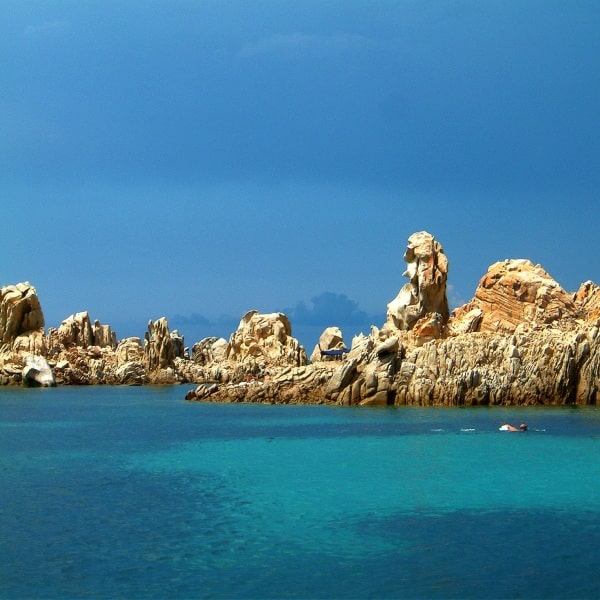
The Costa Smeralda extends along the northeastern coast of Sardinia between the Gulf of Cugnana and the Strait of Bonifacio, a stretch of some 55 kilometers of granite headlands, sheltered coves, and beaches of white sand and water that shifts from turquoise to deep blue depending on the depth and the angle of the light. The coast was developed from the early 1960s onward by a consortium led by the Aga Khan, who imposed strict architectural guidelines — low buildings in local stone, no neon signs, no high-rise — that preserved the natural character of the coastline while creating one of Europe’s most exclusive resort destinations. Porto Cervo, the main village of the Costa Smeralda, is a purpose-built marina town whose whitewashed architecture and carefully tended harbor conceal the infrastructure of a resort that attracts superyachts from across the Mediterranean every summer. The beaches — Capriccioli, Romazzino, Liscia Ruja, Grande Pevero — are consistently ranked among the finest in Italy.
Two Landscapes, One Territory
What makes the Arzachena territory genuinely unusual is the proximity of these two worlds. The giants’ tombs and nuraghi sit in scrubland and granite hills that have changed little in three millennia, while the beaches of the Costa Smeralda lie ten minutes by road in the other direction. A self-drive itinerary that moves between the prehistoric sites in the morning and the coastline in the afternoon covers more experiential ground than most destinations can offer in a full day. The town of Arzachena itself — elevated above the surrounding territory, its granite streets quiet and working-class in contrast to the resort towns below — provides a useful base and a grounding point between the two extremes.
Northeastern Sardinia on a Self-Drive Tour
Arzachena and the Costa Smeralda connect naturally into a broader self-guided tour of Sardinia that can extend south toward the Gallura interior and its winery tours, or north toward the Strait of Bonifacio and the Maddalena Archipelago. The Sardinia region is large enough to sustain a week or more of exploration at a self-drive pace, and the northeast — accessible from Olbia’s port and airport — makes a natural gateway to the island for those arriving by ferry or by air.
Italy Trails at Costa Smeralda and Arzachena
Italy Trails builds the Costa Smeralda and Arzachena nuragic heritage into Sardinian self-drive itineraries with accommodation selected on the coast or in the hills above, nuragic site visits mapped into the daily routes, and local recommendations that move beyond the obvious beach stops. Contact our team to start planning, or learn more about how a self-guided tour works.
To provide the best experiences, we and our partners use technologies like cookies to store and/or access device information. Consenting to these technologies will allow us and our partners to process personal data such as browsing behavior or unique IDs on this site and show (non-) personalized ads. Not consenting or withdrawing consent, may adversely affect certain features and functions.
Click below to consent to the above or make granular choices. Your choices will be applied to this site only. You can change your settings at any time, including withdrawing your consent, by using the toggles on the Cookie Policy, or by clicking on the manage consent button at the bottom of the screen.