
Colosseum Roman Forum Palatine Hill: The Heart of Ancient Rome
The Colosseum, Roman Forum, and Palatine Hill form a single archaeological complex at the center of Rome — three interconnected sites that together tell the story of the city that built an empire and left the most complete record of ancient civilization anywhere in the Western world. The ticket that admits you to the Colosseum covers all three, and walking between them in a single morning is to move through two thousand years of history within the space of a few hundred meters: from the spectacle of the arena to the civic life of the Forum to the private world of the emperors on the hill above. No other archaeological site in the world concentrates this much significance in this small an area, and no amount of prior knowledge fully prepares a visitor for the experience of standing in the Forum and looking up at the Palatine while the Colosseum rises above the Sacred Way behind them.
The Colosseum: Scale and Purpose
The Colosseum was built between 70 and 80 AD under the emperors Vespasian and Titus, and could accommodate between 50,000 and 80,000 spectators in tiered seating arranged by social rank. The engineering that makes the building possible — the system of vaulted corridors, the eighty entrances, the retractable awning that shaded the crowd from the sun — was among the most sophisticated of the ancient world, and the structure that remains today, despite the centuries of quarrying that stripped much of its marble facing, still communicates the ambition and the organizational capability of the civilization that built it. The underground hypogeum — the network of tunnels and machinery beneath the arena floor where animals, gladiators, and scenery were held before being raised into the arena — is accessible on guided visits and offers the most direct insight into how the spectacles were actually staged.
The Roman Forum: The Center of Roman Public Life
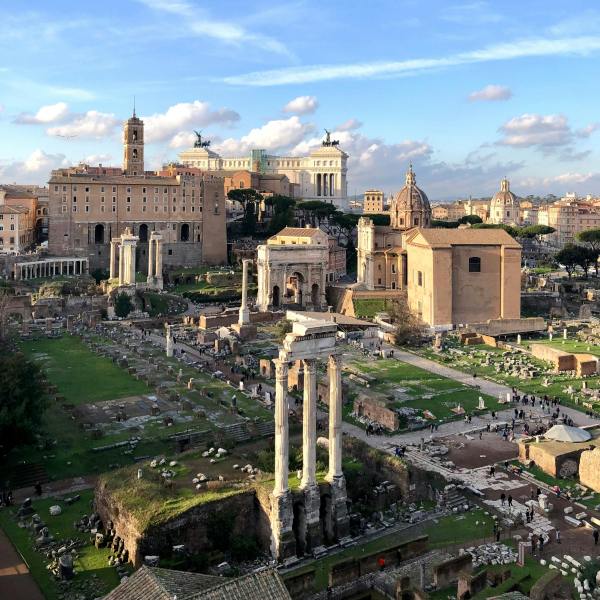
The Roman Forum was for centuries the political, commercial, and religious center of the Roman world — the place where elections were held, laws were proclaimed, and the great public ceremonies of the Republic and the Empire took place. What remains today is a field of ruins that requires some imaginative effort to read, but the effort is rewarded: the Temple of Saturn, the Arch of Septimius Severus, the Basilica of Maxentius, the Temple of Vesta, and the Via Sacra that runs the length of the Forum connect into a coherent picture of a public space that was continuously developed and rebuilt over a thousand years. The view from the eastern end of the Forum — looking back toward the Capitoline Hill with the Arch of Titus in the foreground and the Colosseum beyond — is one of the great views in Rome and worth spending time with before moving on.
The Palatine Hill: Where Rome Began
The Palatine Hill rises above the Forum on the south and was, according to Roman tradition, the site of the city’s foundation — where Romulus traced the boundary of the first settlement in 753 BC. By the imperial period it had become the exclusive residential quarter of the emperors, its slopes covered with palaces of extraordinary luxury whose remains still cover much of the hilltop. The Domus Augustana, the Domus Flavia, and the Palace of Tiberius together form the most complete surviving example of imperial residential architecture in the ancient world. The gardens above the palaces — the Orti Farnesiani, laid out in the 16th century over the ancient ruins — offer the finest panoramic view over the Forum below and the city beyond, and represent one of the most rewarding places in Rome to sit quietly and allow the scale of what surrounds you to register.
Rome and Lazio on a Self-Drive
The Colosseum, Roman Forum, and Palatine Hill are the natural starting point of a Rome itinerary that connects into a broader self-guided tour of Lazio — extending beyond the city to the Etruscan sites of Cerveteri and Tarquinia, the gardens of Villa d’Este at Tivoli, and the volcanic lakes and hill towns of the region. Explore the full Lazio region to see how Rome connects with the surrounding countryside, then contact our team to start planning, or learn more about how a self-guided tour works.
To provide the best experiences, we and our partners use technologies like cookies to store and/or access device information. Consenting to these technologies will allow us and our partners to process personal data such as browsing behavior or unique IDs on this site and show (non-) personalized ads. Not consenting or withdrawing consent, may adversely affect certain features and functions.
Click below to consent to the above or make granular choices. Your choices will be applied to this site only. You can change your settings at any time, including withdrawing your consent, by using the toggles on the Cookie Policy, or by clicking on the manage consent button at the bottom of the screen.