
There is a version of Italy that most travel companies quietly ignore. It is the version seen from a wheelchair, from a mobility scooter, from the perspective of someone who needs a ramp where there are only steps, a lift where there is only a spiral staircase, a flat path where there is only cobblestone.
Italy is not an easy country for travellers with reduced mobility. Anyone who tells you otherwise has never tried to navigate a medieval hill town in a wheelchair, or cross a Venetian bridge on crutches, or find an accessible bathroom in a rural trattoria. The obstacles are real, and they are everywhere.
But here is what is also true: Italy is not impossible. Not even close. It requires planning, local knowledge, the right equipment, and a guide service that understands the difference between “accessible on paper” and “accessible in reality.” That is what we do at Italy Trails. And we have been doing it long enough to know exactly where the path is smooth and where it isn’t.
What We Mean by Accessible Self-Drive
A self-drive trip through Italy with a disability is not the same as a standard self-drive itinerary with a few accessible hotels swapped in. It is a fundamentally different kind of planning, and it starts with a question that most tour operators never think to ask: what can you do, and what do you want to do?
The answer is never the same twice. A traveller with limited leg mobility who can stand briefly has different needs from a full-time wheelchair user. A family travelling with an elderly parent who tires easily requires a different rhythm from a solo traveller with a visual impairment. A couple where one partner has a disability and the other does not need an itinerary that satisfies both, without making the trip feel like a medical exercise.
At Italy Trails, we build every accessible itinerary from scratch, based on the specific needs of the traveller. There is no standard “accessible package.” There is a conversation — detailed, honest, sometimes long — in which we learn what kind of trip you want, what your mobility level is, what equipment you use, and what your non-negotiable experiences are. Then we design the route around the reality, not around the brochure.
The Mobility Scooter Difference
One of the things that sets Italy Trails apart is something most operators have never considered: we arrange the rental of mobility scooters as an integrated part of your itinerary.
This changes everything.
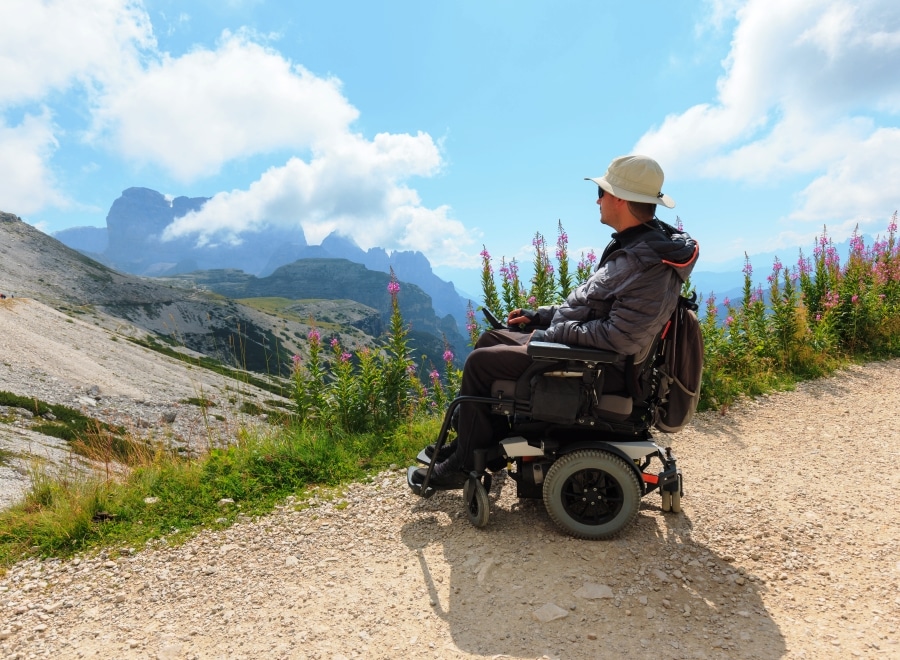
A mobility scooter is not a wheelchair. It is a compact, battery-powered vehicle that gives you the freedom to cover distances that would be exhausting or impossible on foot or in a manual chair. It handles flat terrain, gentle slopes, and paved surfaces with ease. It fits in the boot of a car. And it transforms what we call “moderately accessible” locations — places that are not fully barrier-free but are navigable with the right equipment and a bit of local knowledge — into places you can actually visit and enjoy.
Think of a Roman forum with gravel paths. Think of a coastal promenade with a few shallow ramps. Think of a historic town centre where the main streets are flat but the side alleys climb. On foot or in a manual wheelchair, these places are a challenge. On a scooter, they become part of the trip.
We handle the logistics: sourcing the scooter, arranging delivery and collection at each stage of your route, making sure it is the right model for your needs, and confirming that every accommodation along the way has somewhere to store and charge it overnight. You arrive, the scooter is there, and your trip begins.
Honest About What Works and What Doesn’t
We are not going to pretend that every corner of Italy is accessible. It isn’t, and pretending otherwise would be dishonest and potentially dangerous.
Pompeii is a rough, uneven archaeological site where full wheelchair access is limited to a fraction of the excavations. Cinque Terre is a series of villages connected by steep staircases carved into cliffs. Many of Italy’s most celebrated medieval towns — Civita di Bagnoregio, Spello, Erice — are built on gradients that defeat even the most determined scooter. And rural agriturismi, for all their charm, do not always have lifts or ground-floor rooms.
We know this because we have been there. We have walked the routes, checked the gradients, tested the lifts, measured the doorways, and spoken to the owners. When we say a place is accessible, we mean it. And when we say it isn’t, we mean that too — and we’ll suggest an alternative that gives you the same spirit without the struggle.
This is the value of local knowledge. A guidebook will tell you that the Colosseum has an accessible entrance. It will not tell you that the queue for that entrance on a summer morning can leave you in full sun for forty minutes, or that the accessible path inside skips three of the most interesting sections, or that there is a better time of day and a better approach route that makes the whole experience smoother. We will.
What an Accessible Italy Trails Itinerary Looks Like
Every itinerary is different, but a typical accessible self-drive trip with Italy Trails might look something like this.
You arrive at the airport and are met by a pre-arranged transfer to your first hotel — one we have personally vetted for accessibility: ground-floor room or reliable lift, roll-in shower, adequate turning space, no hidden steps between the car park and the entrance. Your rental car, if needed with hand controls, is waiting. Your mobility scooter is delivered to the hotel and demonstrated to you. Your roadbook — the detailed, step-by-step guide that accompanies every Italy Trails self-drive trip — includes specific accessibility notes for every stop: where to park closest, which entrance to use, which sections to skip, where the accessible bathrooms are, and what to do if something doesn’t work as expected.
Along the route, we mix the unmissable highlights with the quieter, more accessible alternatives that most visitors never find. A flat vineyard visit instead of a hillside winery. A lakeside lunch spot with ramp access instead of a rooftop terrace reached by stairs. A museum with a lift and tactile exhibits instead of one with four floors of marble staircases. The trip doesn’t feel like a compromise. It feels like a different way of seeing the same country — and often, a better one.
And throughout, our team is reachable. Not a call centre. The same people who designed your route, who know the hotels and the scooter supplier and the restaurant owner who will move a table to make room. If something goes wrong — a lift is broken, a road is blocked, a reservation was lost — you call us and we fix it, because we know the people on the ground.
The Regions That Work Best
Over the years, we have developed a detailed understanding of which Italian regions are most rewarding for travellers with reduced mobility. Some highlights:
Puglia is one of the most accessible regions in southern Italy. The Itria Valley is gently rolling rather than steep, and many of the masserie (historic farmhouses turned hotels) have been renovated with ground-floor suites and accessible common areas. The coastal towns of Monopoli, Polignano a Mare, and Trani have flat seafront promenades that are scooter-friendly.
Tuscany beyond the hill towns is surprisingly flat. The Val d’Orcia is best experienced by car — the views are from the road, not from a hiking trail — and many of the larger towns (Montepulciano’s lower town, Pienza’s main street, Montalcino’s piazza) have accessible cores even if the outer streets climb.
Campania requires more care, but Naples itself has made significant progress: the Museo Archeologico Nazionale is fully accessible, the seafront is flat and wide, and the newer metro stations are among the most accessible in Europe. The Amalfi Coast is largely inaccessible by wheelchair, but Ravello’s main villa gardens and Sorrento’s town centre are manageable with a scooter.
Sicily is vast and varied. The Valley of the Temples in Agrigento has an accessible route through its main section. Siracusa’s Ortigia island is largely flat. Taormina, despite its fame, is steep and difficult — but the Greek Theatre has an accessible entrance, and the views from the main corso are worth the visit even without descending to the lower levels.
Why This Matters
Accessible travel is not a niche. Over 80 million people in Europe live with some form of disability, and the number of travellers with reduced mobility grows every year as populations age. Many of these travellers have the means, the desire, and the determination to visit Italy. What they lack is reliable information and a tour operator willing to do the work.
Most travel companies treat accessibility as an afterthought — a filter on a booking engine, a wheelchair icon on a hotel listing, a disclaimer at the bottom of a page. At Italy Trails, it is part of how we think about every route we design. Not because it is fashionable, but because we have seen what happens when a traveller who was told they couldn’t visit Italy arrives at a perfectly accessible piazza on a warm evening, orders a glass of wine, and realises that the country is theirs too.
That moment is why we do this.
Start with a Conversation
If you or someone you travel with has reduced mobility, here is what we would like you to know: there is no form to fill in, no dropdown menu where you select your disability from a list, no algorithm that spits out a “suitable” package. There is a conversation.
You tell us what you dream of seeing. We tell you what is possible, what is difficult, and what we can make work with the right preparation. Together, we design a route that is yours — not a standard itinerary with accessibility bolted on, but a trip built from the ground up around your needs, your pace, and your ambitions. We arrange the accessible accommodation, the scooter, the transfers, the roadbook with every gradient and every ramp noted. You drive, you explore, you stop where you want. We handle the rest.
We have done this before, many times, and every trip has taught us something new. Every client has shown us a corner of Italy we hadn’t looked at from that angle before. That is why we keep doing it — not because accessible travel is a market segment, but because everyone deserves to sit in a piazza on a warm evening and feel that this country belongs to them too.
Get in touch with us at Italy Trails — no commitment, no obligation. Just a conversation about where you want to go, and how we can get you there.
Italy is waiting. And it is more accessible than you think.