
Between Venice and the Lido, where the lagoon loses its postcard shimmer and the water turns the color of old pewter, there is a small island that most Venetians will not name without lowering their voice. Poveglia — three fragments of land divided by a narrow canal, barely visible from the vaporetto — has carried more death within its shores than most cities have known in their entire history. It is not a place of monuments. There are no guided tours, no ticket booths, no gift shops selling miniature gondolas. The Italian government keeps it closed to the public. The buildings are falling. The trees have swallowed the courtyards. And yet, Poveglia remains one of the most written-about, most feared, and most hauntingly beautiful places in all of Italy.
Its story is not one of ghosts, though the ghosts have certainly been claimed. It is a story of plague, exile, medicine, madness, and the particular silence that settles over a place where too many people have suffered. To understand Poveglia is to understand a side of Venice that no museum will show you — the side where beauty and terror have always lived in the same room.
A Small Island in a Great Republic
The earliest recorded mention of Poveglia — then called Popilia, possibly after the Roman road Via Popilia-Annia or the poplar trees that once lined its banks — dates to the year 421 AD, making it as old as Venice itself. During the barbarian invasions that ravaged the Italian mainland in the sixth century, refugees from Padua and Este fled to the lagoon islands, and Poveglia became one of their sanctuaries. For a time, it thrived. The settlement grew into a small but prosperous community of fishermen and salt merchants, largely self-governed and exempt from the taxes imposed on the mainland.
In the ninth century, Poveglia’s inhabitants played a role in the defense of Malamocco — the precursor to Venice — against the Frankish siege of 809-810. Their reward was a measure of autonomy that lasted for centuries. The island’s strategic position at the southern entrance of the lagoon made it valuable: close enough to Venice for trade, far enough to serve as a buffer against enemies arriving from the open sea.
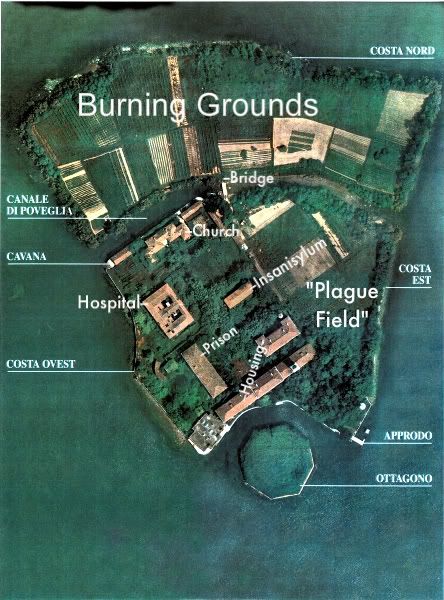
But geography, which had given Poveglia its purpose, would also seal its fate. During the War of Chioggia in 1379, when Genoa attacked Venice in one of the most devastating conflicts between the two maritime republics, the island’s population was evacuated to the more defensible Giudecca. An octagonal fortification was built on a small adjacent islet — it still stands today, one of only four surviving from the five that once guarded the lagoon’s entrances — but Poveglia itself was left hollow. Its residents never returned. For nearly four hundred years, the island sat empty, visited only by fishermen and the occasional soldier.
The Black Death and the Birth of Quarantine
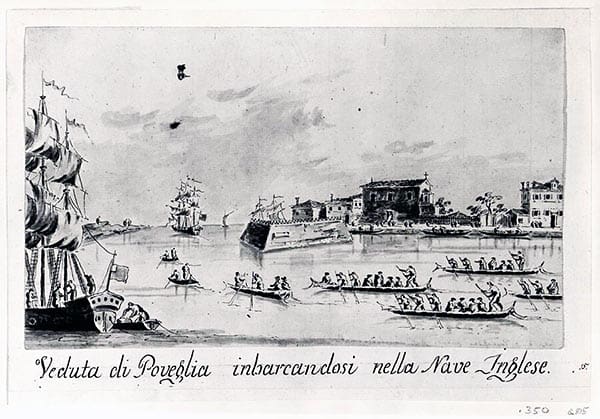
Venice‘s extraordinary wealth came from trade, and trade brought disease. The city was struck by bubonic plague repeatedly — in 1348, in 1575, in 1630 — and each outbreak forced the Republic to confront a terrible arithmetic: how to protect the living without abandoning the dying. The solution was the lazaretto, a word that Venice itself gave to the world. The Lazzaretto Vecchio, established in 1423, is considered the first permanent quarantine station in history. The Lazzaretto Nuovo followed. And when both were overwhelmed, the Republic turned to Poveglia.
In 1776, the Magistrato alla Sanità — Venice’s powerful public health authority — formally designated Poveglia as a checkpoint for all ships entering the lagoon. Every vessel arriving from foreign ports was required to stop at the island for inspection. Passengers and crew were examined for signs of illness. Cargo was fumigated. Those who showed symptoms were confined on the island indefinitely. Those who died — and many died — were buried in mass graves or burned on open pyres, their ashes mixed with the earth until, as local tradition insists, the island’s soil became more human remains than dirt.
The scale of death on Poveglia is difficult to verify with precision, but the estimates are staggering. Some historians place the number of plague victims buried or cremated on the island at over one hundred and sixty thousand. Whether or not the figure is exact, the archaeological evidence is unambiguous: the ground is saturated with human bone. Fishermen in the surrounding waters have long reported pulling fragments of skulls and vertebrae from their nets — and, by custom, throwing the entire catch back rather than keeping anything touched by the dead.
Poveglia remained an active quarantine station until 1814, when Napoleon’s forces dissolved the Venetian Republic and reorganized its institutions. By then, the island had served as a barrier between Venice and the outside world for nearly forty years — a duration that speaks both to the persistence of plague in the Mediterranean and to the Republic’s ruthless pragmatism in managing it. The lazaretto buildings — low stone structures designed for containment, not comfort — were left standing but empty, their walls still carrying the smoke stains of the fumigation fires. Napoleon himself is said to have used the island briefly as a weapons depot, adding one more layer of utility to a place that had never been valued for anything other than its usefulness.
The Asylum Years
In 1922, a new chapter began. The Italian government converted the abandoned lazaretto into a psychiatric hospital, and Poveglia received its second population of involuntary residents. The asylum operated for over four decades, housing patients in the same buildings where plague victims had once been quarantined. The irony was lost on no one.
Details of what happened inside the hospital are scarce and heavily mythologized. The most persistent legend involves a doctor who allegedly performed crude experiments on his patients — lobotomies with hammers and chisels, unorthodox surgeries, psychological torments — before going mad himself and throwing himself from the island’s bell tower. According to some versions of the story, he survived the fall but was strangled by a mysterious mist that rose from the ground. The bell tower, a graceful brick structure visible from across the lagoon, still stands, though the bell itself was removed long ago.
How much of this is true is impossible to say. Italian psychiatric institutions of the mid-twentieth century were, as a general matter, grim places — overcrowded, underfunded, and governed by medical philosophies that would later be recognized as inhumane. Patients were often confined indefinitely, with little distinction made between those suffering from treatable conditions and those deemed simply inconvenient to their families or communities. The physical isolation of Poveglia — surrounded by water, reachable only by boat, invisible from the main city — made it a perfect instrument of erasure. Once committed, a patient effectively disappeared from Venetian society.
The reform movement led by the psychiatrist Franco Basaglia, which culminated in the landmark Law 180 of 1978, eventually closed most of Italy’s psychiatric hospitals and fundamentally changed the country’s approach to mental health. Poveglia’s asylum shut its doors in 1968, a decade before the law was passed, and its patients were transferred elsewhere. The buildings were locked, the furniture left in place, the medical records boxed and presumably archived. No memorial was erected. No public acknowledgment was made.
No one has lived on the island since.
Between Legend and Memory
In the decades following its abandonment, Poveglia became a canvas for the imagination. Ghost hunters, paranormal investigators, and television crews descended on the island — sometimes legally, more often not — in search of evidence that the dead had not entirely departed. The American television series Ghost Adventures filmed an episode on Poveglia in 2009, and the crew later claimed to have experienced physical and psychological disturbances that lingered long after they left. Other programs followed. The island became a fixture of “most haunted places” lists in every language.
Venetians tend to view all of this with a mixture of amusement and unease. The lagoon has always been a place of stories — every island has its legend, every canal its drowned lover or vanished nobleman. Poveglia’s stories are darker than most, but they follow the same pattern: the living project their fears onto places that have absorbed too much suffering. Fishermen still navigate wide around the island. Some claim to have seen flickering lights in the empty wards at night. Others say the silence near Poveglia is different from the silence elsewhere in the lagoon — heavier, thicker, as though the air itself remembers what happened there.
The plague pits are real. The quarantine was real. The asylum was real. The bell tower, the fumigation rooms, the mass graves — all of this happened, and all of it happened on a piece of land smaller than a city block. No supernatural explanation is needed to understand why the place feels wrong. It feels wrong because it is a monument to suffering on an almost incomprehensible scale, and because the suffering has been left exactly where it occurred, unmarked and uncommemoriated, slowly being digested by the vegetation.
The Island Today
Poveglia remains officially closed to the public. Access requires special authorization from the Municipality of Venice, and permits are rarely granted. The buildings — the lazaretto wards, the asylum corridors, the small church that once served both the sick and the mad — are in advanced decay. Roofs have collapsed. Walls are cracked and overgrown with ivy and wild fig trees. The only regular visitors are seagulls and the occasional stray cat.
In 2014, the Italian government, facing financial pressure, attempted to auction the island. The plan drew public outcry and a grassroots campaign by Venetian citizens who argued that Poveglia should remain public property. A businessman named Luigi Brugnaro — who would later become mayor of Venice — submitted the winning bid of five hundred and thirteen thousand euros, but the project stalled and the island’s status remains in limbo. Proposals have ranged from a luxury hotel to a public park to an educational center dedicated to the history of public health. None has materialized.
For now, Poveglia can only be seen from the water. Private boat tours occasionally pass close enough to photograph the bell tower and the crumbling facades, and kayakers exploring the southern lagoon sometimes paddle within view of its shores. On clear days, the island is visible from the Lido, its silhouette low and dark against the water — an improbable presence in a city that has built its entire identity on light. At sunset, when the lagoon turns copper and the bell tower catches the last glow, Poveglia is almost beautiful. Almost. There is always something slightly wrong about the light on that particular shore, as if the island absorbs warmth rather than reflecting it.
The lagoon around Venice holds dozens of islands, each with its own character and history. Murano has its glass, Burano its lace, Torcello its ancient mosaics. Poveglia has its silence. It is a silence that feels earned — the kind that settles over a place not because nothing is happening, but because too much has already happened. Whether the island will ever be reopened, restored, or given a new purpose is a question that Venice has been avoiding for decades. In the meantime, Poveglia waits, as it has waited for centuries, between the city and the sea, holding its dead close to the surface.
Exploring the Venetian Lagoon
While Poveglia itself remains off-limits, the Venetian lagoon offers countless opportunities for those drawn to its quieter, more mysterious corners. The lagoon is best explored at your own pace, away from the crowds of San Marco, and a self-guided journey through the Veneto region allows you to discover not only Venice but also the lesser-known islands, the fishing villages of Pellestrina and Chioggia, and the mainland cities — Padua, Verona, Vicenza — that shaped the history of the Republic. Italy Trails specializes in exactly this kind of independent travel through Italy, designing self-guided itineraries that give you the freedom to follow your curiosity wherever it leads — even to the edge of a forbidden island.