
Tivoli Renaissance Gardens: Two UNESCO Sites Above the Roman Campagna
The Tivoli Renaissance gardens are among the finest examples of Italian garden design in the world — a tradition of landscape art that reached its peak in the 16th century on the hills above Rome, where the cardinal families of the papal court competed to create the most spectacular expressions of humanist culture and aristocratic power in stone, water, and living plant material. Tivoli, thirty kilometers east of Rome on the edge of the Tiburtine hills, contains two UNESCO World Heritage Sites within a few kilometers of each other: the Villa d’Este with its extraordinary Renaissance garden, and the Villa Adriana, the vast imperial retreat that the Emperor Hadrian built in the early 2nd century AD as a personal recreation of the most beautiful places he had encountered in his travels across the empire. Together they represent two of the most significant cultural sites in the Lazio region and two of the most rewarding half-days in the Roman countryside.
Villa d’Este: Water, Geometry, and Ambition
The Villa d’Este was created from 1550 onward by Cardinal Ippolito II d’Este, who transformed a Benedictine convent and its hillside site into one of the most ambitious garden projects of the Renaissance. The garden descends from the villa in a series of terraces connected by ramps and staircases, organized around a central axis and animated throughout by an extraordinary hydraulic system that feeds hundreds of fountains, cascades, and water features from a single diversion of the Aniene river above the town. The Viale delle Cento Fontane — the Avenue of a Hundred Fountains — is the most celebrated element of the garden: a long horizontal terrace lined on one side by a continuous wall of mossy jets and sculptural relief that runs the full width of the property. The Fontana dell’Ovato, the Fontana di Nettuno, and the Fontana dell’Organo — a hydraulic organ that plays music using water pressure — add further drama to a garden whose ambition and technical sophistication defined the Italian garden tradition for the following two centuries and influenced garden design across Europe.
Villa Adriana: An Emperor’s Private World
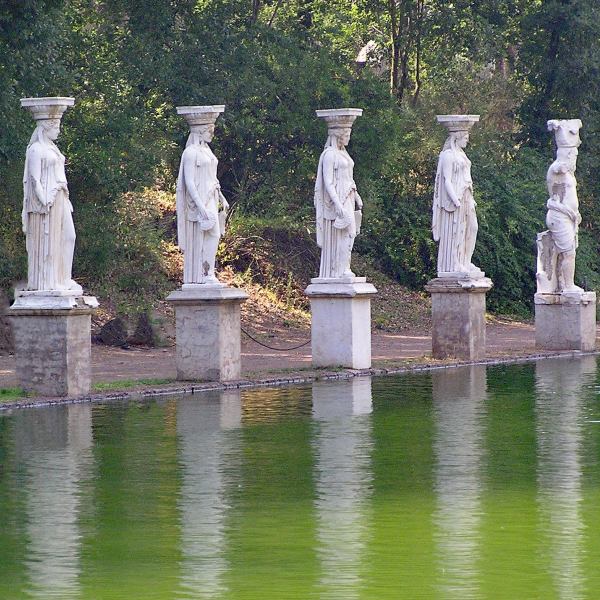
Two kilometers below the town of Tivoli, Villa Adriana covers an area of roughly 120 hectares — larger than the entire ancient center of Rome — and was built by the Emperor Hadrian between approximately 118 and 138 AD as a retreat from the capital and a personal compendium of the architecture and landscapes he admired most. The Canopus, a long reflecting pool modeled on the Egyptian sanctuary of Serapis near Alexandria, is the most photographed element of the complex: a rectangular basin lined with columns and statues that ends in a curved dining pavilion where Hadrian entertained his court. The Teatro Marittimo — a circular island surrounded by a moat, connected to the surrounding building by a moveable bridge — is believed to have been Hadrian’s private retreat within the retreat, a space where the emperor could withdraw from even his own household. The baths, the libraries, the guest quarters, and the administrative buildings that fill the rest of the site give a sense of the scale and the ambition of a man who governed the largest empire in the ancient world and chose to spend his final years building an entire city for himself.
Tivoli on a Lazio Self-Drive
A self-drive to Tivoli from Rome takes approximately forty minutes on the A24 motorway and can be combined in a single day with a visit to both UNESCO sites — Villa Adriana in the morning, Villa d’Este in the afternoon, when the late light catches the water features at their most dramatic. The day connects naturally into a broader self-guided tour of Lazio that can
To provide the best experiences, we and our partners use technologies like cookies to store and/or access device information. Consenting to these technologies will allow us and our partners to process personal data such as browsing behavior or unique IDs on this site and show (non-) personalized ads. Not consenting or withdrawing consent, may adversely affect certain features and functions.
Click below to consent to the above or make granular choices. Your choices will be applied to this site only. You can change your settings at any time, including withdrawing your consent, by using the toggles on the Cookie Policy, or by clicking on the manage consent button at the bottom of the screen.