
Trabocchi of Molise: Ancient Fishing Machines on the Adriatic Coast
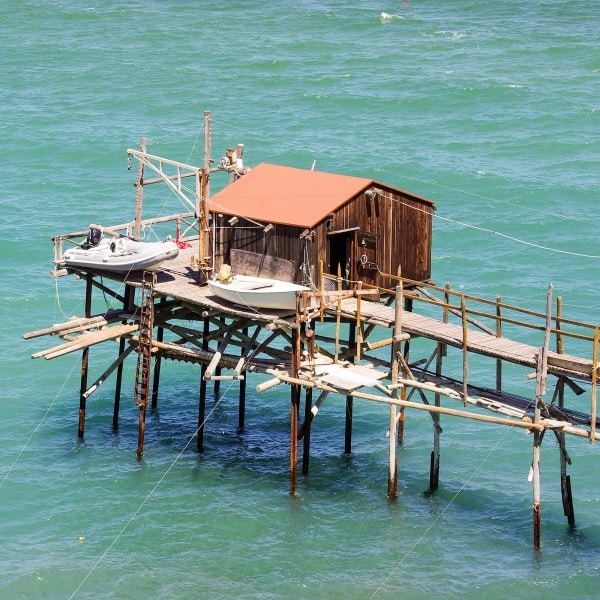
The trabocchi of Molise are one of the most visually striking and historically distinctive features of the Italian Adriatic coast — ancient wooden fishing platforms built on piles driven into the rock, extending out over the sea on a web of beams and cables, with long arms carrying nets that are lowered and raised by a system of pulleys and counterweights that has not fundamentally changed in centuries. These extraordinary structures, found along the short but remarkable stretch of Molise’s coastline between Termoli and the border with Abruzzo, are part fishing machine, part architectural curiosity, and part living connection to a way of working the sea that has almost entirely disappeared from the rest of the Mediterranean. To discover the trabocchi of Molise is to encounter something genuinely rare — a tradition that survived here precisely because this coast remained remote enough to preserve it.
What a Trabocco Is and How It Works
A trabocco is built on a natural rock ledge or promontory, with a platform of wooden beams extending out over the water and a system of long arms — the antenne — that project further still, carrying a large square net suspended by ropes and pulleys. The net is lowered into the water, left for a period, and then raised by turning a wooden winch on the platform, bringing up whatever fish have passed beneath it. The system requires no active pursuit of the fish — it is entirely passive, dependent on the currents and the seasonal movements of the fish along the coast. Each trabocco was traditionally owned and operated by a single family, passed from generation to generation along with the knowledge of the best positions, the right seasons, and the particular behavior of the fish in that stretch of water. The structures require constant maintenance — the sea and the salt air work continuously against the wood — and those that survive today are monuments to the persistence of the families who kept them standing.
The Coast of Molise: Termoli and the Trabocchi Road
Molise has the shortest coastline of any region in Italy — barely 36 kilometers from the border with Abruzzo in the north to the border with Campania in the south — but those kilometers are among the most characterful on the entire Adriatic. Termoli is the only significant coastal town, its medieval old city built on a promontory with a Norman castle and a cathedral that contains the relics of San Basso and San Timoteo, patrons of the city, brought here from the east in the early medieval period. The old town of Termoli, known as the Borgo Vecchio, preserves its medieval street plan almost entirely intact, its narrow lanes and whitewashed houses giving it a character quite different from the modern resort town that surrounds it on the landward side. Along the coastal road north of Termoli, several trabocchi are still visible from the road and from the sea — some still operational, some converted into restaurants where fish caught from the platform is served directly to diners.
Eating at a Trabocco
One of the most distinctive experiences the Molise coast offers is lunch or dinner at a trabocco that has been converted into a restaurant. The setting is unlike anything else in Italy: a wooden platform over the sea, the nets hanging from the arms above, the water visible through the gaps in the planking below, and a menu built entirely around whatever the coast and the season provide. Brodetto, the fish stew of the Adriatic coast, appears in a Molise version that differs subtly from the versions made in Abruzzo, Marche, and further north — less saffron, more tomato, and a selection of fish determined by the catch rather than by a fixed recipe. Eating here, with the sound of the sea below and the trabocco structure creaking gently in the wind above, is an experience that belongs to this specific stretch of coast and cannot be replicated elsewhere.
The Trabocchi of Molise and the Adriatic Coast on a Self-Drive
The trabocchi coast connects naturally into a Molise self-drive itinerary that combines the coast with the rolling hills and villages of the interior — a contrast between Adriatic coastline and Apennine landscape that covers more experiential ground than most regions can offer in the same distance. Termoli is also the departure point for ferries to the Tremiti Islands, a small archipelago of extraordinary natural beauty in the northern Adriatic that extends the coastal itinerary still further. Explore the full Molise region to see how the trabocchi coast fits into a complete regional itinerary, and find out how it connects with a broader self-guided tour of southern Italy.
Italy Trails and the Trabocchi of Molise
Italy Trails builds the trabocchi of Molise into southern Italy self-drive itineraries with accommodation selected in Termoli or along the coast, trabocco restaurant reservations included in the travel materials, and routes that connect the Adriatic coastline with the Molise interior and the regions beyond. Contact our team to start planning, or learn more about how a self-guided tour works.
To provide the best experiences, we and our partners use technologies like cookies to store and/or access device information. Consenting to these technologies will allow us and our partners to process personal data such as browsing behavior or unique IDs on this site and show (non-) personalized ads. Not consenting or withdrawing consent, may adversely affect certain features and functions.
Click below to consent to the above or make granular choices. Your choices will be applied to this site only. You can change your settings at any time, including withdrawing your consent, by using the toggles on the Cookie Policy, or by clicking on the manage consent button at the bottom of the screen.