
There is a palace in Naples where the walls are made of paper.
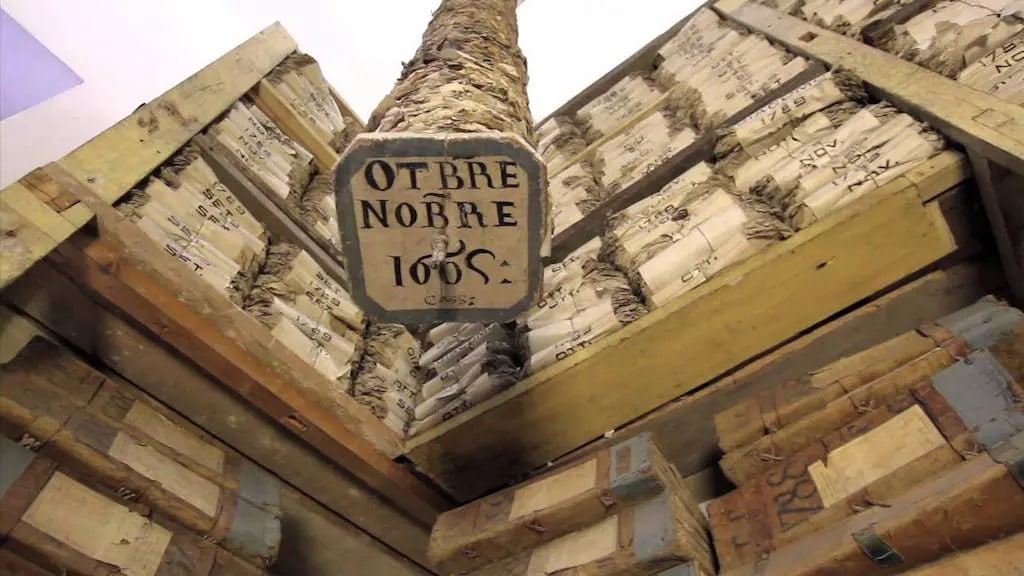
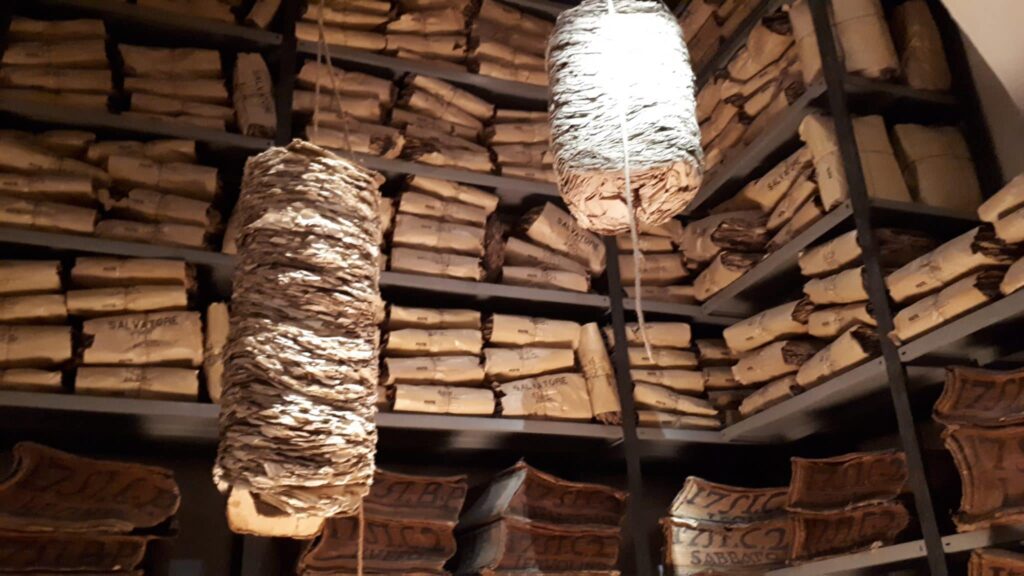
Not literally, of course. But step inside Palazzo Ricca on Via dei Tribunali — the ancient decumanus that has cut through the city’s heart since the Greeks laid its first stones — and you’ll understand the metaphor. Three hundred and thirty rooms. Eighty kilometres of shelving. Hundreds of thousands of handwritten volumes stacked floor to ceiling, filling every corridor, every chamber, every forgotten alcove of this sixteenth-century building. The air itself feels different here, thick with the quiet weight of half a millennium of human transactions.
This is Il Cartastorie, the museum of the Historical Archive of the Banco di Napoli. And it is, without exaggeration, one of the most astonishing places in Italy that almost nobody talks about.
Where Money Becomes Memory
To understand Il Cartastorie, you need to forget everything you think you know about banking archives. This is not a place of dry ledgers and meaningless columns of figures. What is preserved here — in meticulous detail, across 450 unbroken years — is the daily life of an entire civilisation.
It starts with a peculiarly Neapolitan invention: the fede di credito, or “certificate of credit.” Beginning in the late 1500s, the city’s public banks developed a system that was revolutionary for its time. When you deposited money, you received a paper document — not unlike a modern cheque — that could be used to pay for goods and services. But here’s what makes these documents extraordinary: each one required a detailed written explanation of why the payment was being made.
Not a code. Not a reference number. A full, narrative description.
And so the bankers of Naples — without intending to — became the most prolific chroniclers of their age.
The Stories Hidden in Receipts
Imagine holding a piece of paper from 1607 and reading that a sum was paid to a certain Michelangelo Merisi — better known as Caravaggio — for a painting depicting the seven works of mercy, to be hung in the chapel of the Pio Monte della Misericordia. The document doesn’t just record the amount. It describes the commission, the expectations, the arrangement between artist and patron.
Now multiply that single document by millions.
Within the archive’s volumes lie the payment records for some of the greatest works of art ever created in southern Italy. The construction of churches, palaces, and fountains. The salaries of musicians at the Royal Chapel. The cost of staging operas. The fees paid to sculptors, gilders, marble-cutters, and fresco painters whose names history has otherwise forgotten. Every transaction tells a story, and every story opens a window onto a world that guidebooks rarely reach.
But it’s not only the famous names that make this archive extraordinary. Alongside the payments to Caravaggio and the commissions for grand Baroque altarpieces, you’ll find the records of ordinary Neapolitans pawning their few possessions at the Monte dei Poveri — the Bank of the Poor — in exchange for enough money to eat. A woman’s coral necklace. A man’s only coat. A set of silver buttons inherited from a grandmother. These were the objects that the desperate brought to the bank’s counters, and the clerks dutifully recorded each one, noting its condition, its estimated value, and the name of the person who surrendered it.
In these pages, the poor of Naples are not anonymous. They have names, addresses, trades. They exist.
A Palace of Stories
The museum itself is a work of imagination. Opened in 2016 inside Palazzo Ricca — which served as the headquarters of the Banco dei Poveri from 1616 — Il Cartastorie transforms the archive’s raw material into something visceral and emotional through a permanent multimedia installation called Kaleidos.
Created by Stefano Gargiulo of Kaos Produzioni, the experience takes visitors through rooms where enormous projected images, ambient soundscapes, and spoken narratives bring the documents to life. You walk among towering stacks of ancient volumes while voices whisper the stories they contain. Light shifts across the spines of books that no one has opened in centuries. The effect is not unlike entering a cathedral — except here, the sacred texts are financial records, and the prayers are purchase orders.
One room is dedicated to Raimondo di Sangro, the Prince of Sansevero, whose payment records reveal a man far more complex than the legends suggest. The archive’s causali — those meticulous payment descriptions — strip away centuries of myth to show the real expenditures behind his alchemical experiments and artistic commissions. Another room confronts visitors with the reality of slavery in seventeenth and eighteenth-century Naples: human beings bought, sold, and occasionally ransomed, their physical descriptions recorded with the same bureaucratic precision as the weight of a bolt of silk.
There is also a space called the Angolo Cuomo, an interactive room where visitors can explore the connections between the archive’s documents and the physical city outside the windows. Buildings you walked past on your way here suddenly acquire new dimensions — you learn who paid for their construction, how much the marble cost, which craftsmen carved the cornices, and sometimes, who was cheated in the process.
The Invention That Changed Everything
What makes the Neapolitan banking system particularly fascinating is that it represented one of the earliest experiments in paper-based finance in Europe. The eight public banks that eventually merged to form the Banco di Napoli — among them the Banco della Pietà, the Banco dello Spirito Santo, and the Banco dei Poveri — were founded not by merchants or aristocrats, but by charitable and religious institutions. Their original purpose was to fight usury: to offer the poor an alternative to loan sharks by accepting pawned goods and issuing credit without interest.
This meant that from the very beginning, the Neapolitan banks served everyone — from viceroys financing wars to fishermen pawning nets. The archive, therefore, is not a record of the elite. It is a record of an entire society, top to bottom, captured in the act of spending, saving, borrowing, and hoping.
Governments used the banks to fund public works and military campaigns. Artists received commissions. Nuns bought provisions for their convents. Families paid for weddings, funerals, and dowries. The price of a kilogram of flour during the Neapolitan Republic of 1799 is here. So is the cost of fireworks for the festival of San Gennaro in 1683. So is the fee a barber-surgeon charged for pulling a tooth in 1721.
Why It Matters Now
In an era when we debate the ethics of data collection and digital footprints, Il Cartastorie offers a startling historical mirror. Five hundred years ago, a system designed to protect the vulnerable inadvertently created the most detailed record of daily life in the pre-modern Mediterranean. Every fede di credito was, in its own way, a data point — a fragment of human intention preserved in ink on paper.
The difference, of course, is that no algorithm harvested this information. No corporation monetised it. It simply accumulated, year after year, volume after volume, until the weight of accumulated human experience filled 330 rooms of a Neapolitan palace.
Today, the Fondazione il Cartastorie works not only to preserve these documents but to make them accessible — to scholars, to artists, to anyone willing to slow down long enough to listen to what the paper has to say.
Finding Il Cartastorie
Palazzo Ricca stands at Via dei Tribunali 213, near the eastern end of the decumanus, just steps from the imposing mass of Castel Capuano. It’s a part of Naples that most tourists pass through quickly on their way to somewhere else — the cathedral, perhaps, or the cloister of Santa Chiara. But this is precisely the kind of place that rewards those who wander off the obvious path.
Guided tours are available on weekends, led by young guides from the cultural association Nartea who bring genuine passion to the storytelling. The Kaleidos multimedia experience runs on a schedule, so it’s worth checking times in advance. But even without the multimedia, simply standing in the archive’s corridors — surrounded by centuries of handwritten memory — is an experience that shifts something inside you.
You begin to understand that a city is not made of stone and mortar alone. It is made of transactions, agreements, promises, debts, and gifts. It is made of all the small, urgent reasons people had for handing money to one another across a counter. And in Naples, miraculously, someone wrote every single one of them down.
If places like Il Cartastorie remind you why you fell in love with Italy in the first place, explore more of the country’s hidden stories on Italy Trails — where every itinerary is designed to take you beyond the obvious.
Eighty kilometres of paper. Four hundred and fifty years of stories. And a palace that remembers everything.
Discover Italy’s Hidden Side
Il Cartastorie is just one of the countless secrets waiting along Italy’s less-travelled roads. Browse our self-guided itineraries through Campania and southern Italy and start planning a journey that goes deeper.